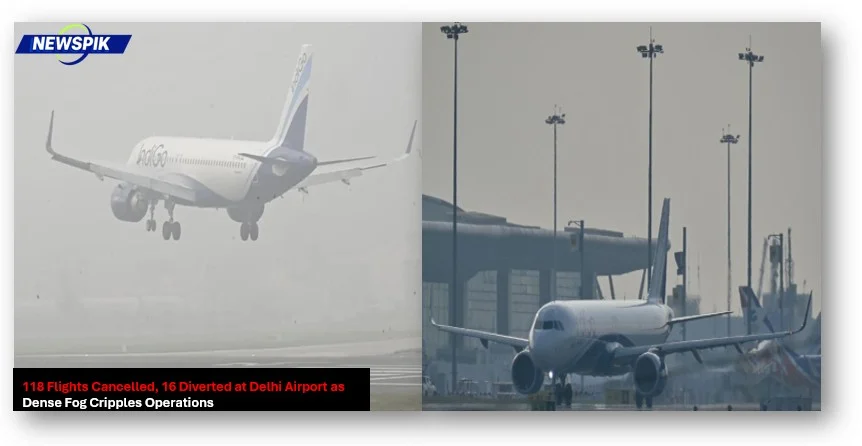

The worst hit airport in India once again became a near standstill on Tuesday due to the severe winter fog that severely disrupted the activities of flights at the Indira Gandhi International Airport (IGIA), Delhi. Hundreds of passengers were grounded, and numerous cancellations and delays were reported due to low visibility, highlighting the frequent problems faced by aviation authorities during the fog season in the national capital
Severe Interruptions during the Day
Airport authorities said that no fewer than 118 flights were cancelled, comprising 60 arrivals and 58 departures, and 16 flights were diverted to other airports as pilots grappled with poor visibility. There were also over 130 flights that were delayed, and this caused chaos in the travel plans of thousands of domestic and international passengers.
The disruptions affected all airlines that fly in and out of IGIA, which, on average, receives approximately 1,300 flights a day and is one of the busiest aviation sectors in Asia. Some of the flights were kept on the ground for hours, and the ripple effect of aircraft and crews being out of place was felt throughout the country.
Flight-tracking site Flightradar24 said the average delay per flight was approximately 28 minutes, but most flights had much longer wait times, with some passengers spending hours stuck inside the aircraft and terminals.
Navi Mumbai International Airport – Made Operational from today!
CAT III Operations Underway, But Heavy fog in Stages
The Delhi International Airport Limited (DIAL), which handles IGIA, also reported that there was a low-visibility procedure in place and operations were under instrument landing guidance systems. But those flights that were not CAT III compliant could not take off or land in the middle of the intense fog.
The CAT III instrument landing systems enable specially trained pilots and equipped airplanes to be able to work under near-zero visibility. Nevertheless, there are many planes worldwide that cannot operate under CAT III, and thus cause unavoidable disruptions.
DIAL wrote in a post on X (formerly Twitter)
Everything on the flight side is going on as normal, and CAT III procedures are operational. Not all flights are CAT III compliant, and this may affect flights in dense fog.
Passenger Inconvenience and Safety Measures
Within terminals, we had long queues as people waited to be updated. Numerous passengers became angry about poor communication and a lack of clarity of modified schedules. Others said they received the notification on cancellations after hours of waiting.
In recognition of the scenario, the Civil Aviation Ministry came out with stringent guidelines to the airlines and told them to observe passenger care protocols. These include:
- Real-time and timely flight details.
- Food and beverages for delayed passengers.
- Free rebooking options or refunds of cancelled flights.
- No refusal to check in after a legitimate check-in.
- Help with luggage problems.
- Quick complaint-solving processes.
Authorities reaffirmed that the security of passengers was the number one priority. Law enforcement also encouraged passengers to arrive at the airport early and monitor flight status and updates regularly on airline websites and airport notifications.
More Niche Effect of Aviation Network
Delays that are associated with fog in Delhi are likely to have a ripple effect on other key airports in India. Grounded or diverted aircraft caused delays in a number of connecting flights between cities such as Mumbai, Bengaluru, Kolkata, Hyderabad, Jaipur, and Chandigarh.
According to aviation professionals, winter fog in northern India is one of the aviation industry’s most significant operational challenges. Despite the technological upgrades such as CAT III installations, which have gone a long way in assisting, unpredictable weather intensity and unexpected decrease in visibility still lead to interruptions.
Fog Season Expected to Linger
Meteorologists have cautioned that heavy fog conditions would continue to affect the northern plains in the coming few days, particularly in the late-night and early-morning hours. Passengers whose flights are booked in the next week have been advised to:
- Retain buffer time in traveling arrangements.
- Avoid tight connections
- Fly in the morning or afternoon when the visibility is better.
- Official airline communication channels should be used rather than third-party updates.
Police are Still On Guard
Close coordination is still maintained in the airport operations teams, Air Traffic Control, meteorological departments, and airline operators. Emergency teams are available at the standby level to ensure passenger safety and handle on-the-ground logistics.
Despite the technology, the most recent upheaval shows that winter fog has been a challenge for aviation in Delhi. With heavy fog covering the capital every season, the authorities are walking a fine line between operational continuity and passenger safety.

A versatile writer mainly works on trending news, daily updates from politics, business, crime, current affairs and entertainment.









