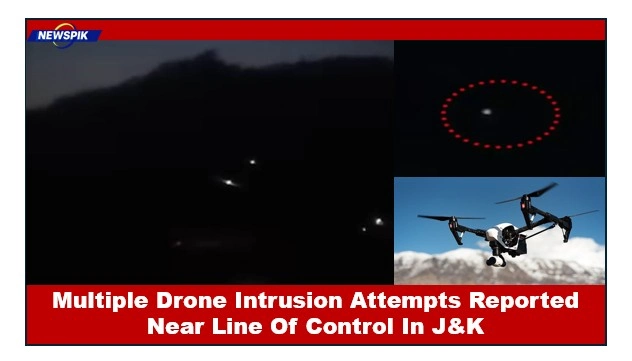

A peaceful Sunday evening in the border districts of Jammu and Kashmir was broken by the Indian Army after it shot down several Pakistani drones that allegedly tried to breach Indian airspace. These simultaneous acts of penetration on Samba, Rajouri and Poonch sectors have once-again raised the alarm over the changing character of cross-border threats. The night sky sparking with international border/LoC exchanges of fire has become a metaphor for continued security consternation amongst the people living in the vicinity of the LoC and IB.
A Coordinated Aerial Infiltration
The 11 January 2026 events were not appropriate single incidents but seemed coordinated. At least five separate drone movements were picked up by high-tech surveillance gear and alert sentries, defense sources said. They were reported to have started at the early evening when a private drone was sighted moving from Tain area towards Topa in Mankote sector of Poonch around 6:25 PM.
Soon after, at around 6:35 PM, the focus shifted to Nowshera sector in Rajouri. It was detected by Indian Army troops located in Gania-Kalsian village. Exhibiting swift reaction drills, the troops immediately brought down heavy and accurate fire on the target with Light Machine Guns (LMGs) and Medium Machine Guns (MMGs). The quick reaction also resulted in the aerial invader fleeing across the LoC before reversing course and heading back towards Pakistan. At the same time, another drone with blinking light was observed flying over Khabbar village Teryath towards Bharakh from Dharmsal.
The violence also spread to the Samba district in nightfall. In Chak Babral village of Ramgarh sector, an object similar to a drone was seen flying for few minutes around 7:15 pm. (video) Recoveries While no drones were shot down in the Sunday night instances, the increasing number and spread of reported sightings have led to a widespread “level-one” security alert across all borders spread over entire Jammu division.
The Target: Arms, Drugs and Surveillance
A sudden surge in air activity is rarely coincidental. Security analysts think these drones are being used both to keep Indian troops under watch and smuggle “narco-terror” payloads. These sightings come within 48 hours of a major bust in Samba sector by the security forces.
The packet dropped by a cross-border drone included:
- Two 9 millimeter pistols (a made-in-China and a Glock).
- Three magazines, and 16 live rounds of ammunition.
- One advanced Chinese hand grenade.
The recovery of such sophisticated weapons indicated the drones seen on Sunday may have been trying to unload similar consignments for “sleeper cells” or local terror collaborators, officials said. To circumvent the existing tradition ground-based infiltration channels, widely covered with multi-tier fencing and electronic surveillance by the Indian Army, handlers across the border were using small and low-flying drones on LoC to drop weapons.
Fresh Threat Rhetoric Raises Alarm- Masood Azhar Claims Massive Suicide Force
Beyond Operation Sindoor
The Indian military was able to do that last year in a big-time counter-UAS initiative where they defeated many dozens of enemy drones and destroyed multiple launch locations along the border.
The relatively peaceful period post-Operation Sindoor gave the illusion of having seen off the threat. But the events of early 2026 indicate that terror handlers have evolved. The drones now in use are frequently smaller, quieter and capable of more dynamic flight paths — making them less detectable to the eye or on conventional radar systems. This “game of cat-and-mouse” in the sky involves continuing updating and upgrading by Indian Army its electronic warfare abilities, including use of jammers-cum-spoofers and drone-catching nets.
Ground Realities and Search Operations
Local villagers have been drafted into the security grid, and “Village Defence Guards” (VDGs) have been instructed to report any sightings of what they term as blinking lights or low-humming sounds in the sky. The psychological toll on these border towns is real. They trust in the ability of soldiers to defend them, but as ground-level battles are replaced by “invisible” threats from the sky, life has taken on a fresh edge of trauma.
Gunfight Erupts in Kathua, 3 Jaish Terrorists Believed Trapped
The Path Ahead: Technology and Vigilance
With the Republic Day celebrations round the corner, security agencies are taking no chances. There are intelligence inputs that the peace of the Union Territory could be disturbed through these “low-cost, high-impact” aerial devices.
The Indian government has expedited the purchase of Desi anti-drone systems from DRDO and private defence startups. These can theoretically detect drones several kilometers away, and “soft-kill” them by jamming their GPS or communication links – or just outright shoot them down using lasers or kinetic projectiles.
The intrusions, even the recent ones close to the LoC, are a ”reminder” that while no traditional artillery shelling happens on the border, it still is “active”, sources said. Now the sound of the night is a battlefield of waving signals, listening devices and shadows. The mission is simple for the Indian Army – if the soil on which it treads has to be secure, so must the skies.

I am a versatile content writer from the MP region, covering politics, business, crime, current affairs, entertainment, video games, and sports with clear insights, engaging analysis, and timely, reader-focused updates.









