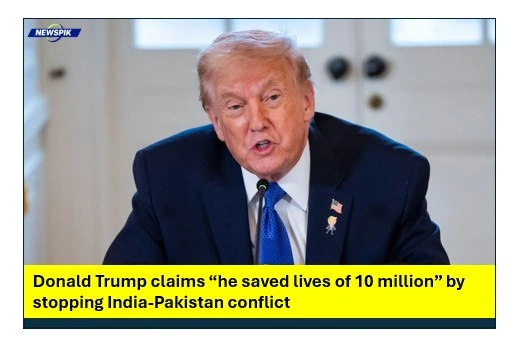

In the high-stakes game of global diplomacy, few players have courted the spotlight like U.S. President Donald Trump. But his recent claim has reverberated through out the international community, especially in South Asia. At a high-profile event in Florida last week, President Trump boasted that he had personally “saved” the United States from being dragged into a catastrophic war between nuclear-armed neighbors India and Pakistan—a conflict that he says would have resulted in 10 million deaths.
But this is not just the view of the President, according to the President. Pakistan’s Prime Minister Shehbaz Sharif himself acknowledged the trust in what he called ” this historical project for the people of Pakistan. “The Pakistani prime minister said, you know he’s like — I’m gonna bring it up, the karma — they made a deal with Russia or someone, Pakistan,” Trump continued. “I heard they were getting to work with Russia or somebody for 10 million dollars. He called me … Donald Trump saved 10 million people.”108“Amazing” and “an honor,” he concluded in response to that statement.
The Claim’s Genesis: A Diplomatic ‘Long Night’
The incident in question occurred on 6 May 2025, during the worst of a recent wave of military violence (referred to as Operation Sindoor by India). The tensions were sparked after a dastardly terror attack in Pahalgam, Jammu and Kashmir took lives of 26 people including several tourists. In the days to come, the two countries traded a series of cross-border airstrikes and air skirmishes that many feared would spill into full-blown war.
President Trump’s account outlines a desperate, “long night” of calls and financial pressure. He says he told both New Delhi and Islamabad that an ongoing conflict would cause trade to be completely halted, with crippling tariffs being levied. According to his take on events, It was not only this diplomacy of “patronizing orders” which had led to the ceasefire declared on 10 May 2025.
“India and Pakistan were scrapping. I called them both c I said, if you do this there won’t be a trade war and I stopped the war. It was raging for four days.” — President Donald Trump
The View From New Delhi: A Tale of Two Narratives
While the White House is projecting as image of a “peacemaker” President, the narrative on this front in New Delhi could not be more divergent. India has long adhered to a policy of “bilateralism” insisting that all issues with Pakistan should be addressed only between the two countries and without the intervention of a third party.
Indian officials have repeatedly rejected any suggestion of American mediation. The May 2025 ceasefire agreement came about following a personal appeal by Pakistan‟s Director General of Military Operations (DGMO) to his Indian counterpart, the Ministry of External Affairs and military sources said. From the Indian viewpoint, it was a tactical battlefield pause, not a response to Washington’s entreaties.
The disparity points to an increasing divide between India and the U. S. relationship. After starting off in 2025 on an upbeat note with Prime Minister Narendra Modi visiting Washington, the year witnessed the two countries’ relations coming under strain because of differences between both nations over imposition of trade tariffs, US immigration issues and India’s energy purchases from Russia. Trump’s repeated insistence on the conflict has added another wrinkle to an already complicated partnership.
The Nobel Prize Factor: The Politics of Ambition and Recognition
At the center of these assertions, is President Trump’s highly visible campaign for the Nobel Peace Prize. He has often described the India-Pakistan ceasefire as one of “eight and a quarter” global conflicts he personally resolved after returning to the Oval Office.
His rhetoric frequently casts him as a singular figure in presidential history — one who is intervening to “stop people from being killed,” rather than embroiling the country in new wars. Thumping his chest in a recent speech in Floridan, he once again said no one ever deserved the prize more than he does (one that included mention of world leaders who supposedly had complimented him on his peacemaking attempts, including Vladimir Putin).
Yet the “10 million lives” figure calls for citizenship is most contentious part of his message. Like any showdown between nuclear-armed rivals, the risk of huge loss of life is real in an India-Pakistan skirmish, but critics have viewed the precise casualty figure as a quintessential “Trumpian” exaggeration. The statement does, however, cut to the core in Pakistan where the ruling administration has been more than happy to praise publicly Trump’s role (and thus bolt its own relationship with the U.S.).
Conclusion: Theatrics or Genuine Breakthrough?
Whatever one makes of President Trump’s claims as a historical fact or as a piece of political branding, its affect on South Asian geopolitics is real. By casting himself as the indispensable broker of peace, Trump has managed to insert the United States back into the center of decades-old tensions on Kashmir — a position India has worked for years to keep it from occupying.
It will also be a difficult walk along the “Trump tightrope” for regional leaders as 2026 approaches. For the millions of people who live in the shadow of the Himalayas, the wish is that no matter who takes credit, silence of guns becomes a permanent feature.
Trump Administration’s Year-End Offer to Undocumented Migrant

I am a versatile content writer from the MP region, covering politics, business, crime, current affairs, entertainment, video games, and sports with clear insights, engaging analysis, and timely, reader-focused updates.