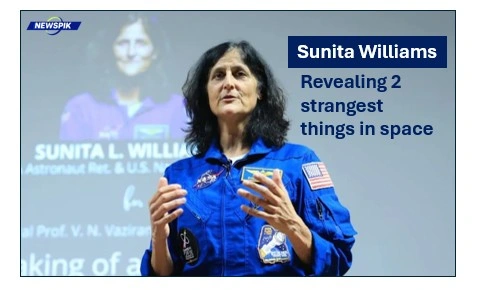

Sunita Williams, one of the most accomplished space explorers of her generation and celebrated Indian-American NASA astronaut, shared a vivid memory from her several-decade-long career in orbit-including what to her remains two of the weirdest visions she ever saw in space. Williams retired after a stellar 27-year career from NASA in December 2025 and talked candidly about these experiences in a recent podcast appearance with Indian entrepreneur Raj Shamani.
From the growing swarm of satellites circling Earth to rare atmospheric flashes above thunderstorms, Williams’ reflections upon these point not just to scientific marvels but also to an emotional and sensory depth of life beyond our planet. Here is what she described in detail.
A Sky Full of Satellites: A New Vision from Orbit
Perhaps one of the most striking things Williams said she saw in space was the number of satellites orbiting Earth-a vision she said she never appreciated until seeing it firsthand from the ISS.
Williams explained that while satellites are integral to modern communications, navigation, weather forecasting, and scientific research, the density of objects in orbit has grown drastically, especially in recent years. She noted that constellations of communication satellites — including those launched by private companies — now crisscross the skies in ways that were unimaginable during earlier space missions.
“There’s a lot of stuff in orbit around the planet — a lot of communication satellites,” Williams said. “Seeing them all from the station really made an impression on me.”
What Williams described wasn’t just a distant technological network-it was a visual reminder of how much human activity has extended into space. To astronauts living on the ISS, these satellites are not just data points; they are continuously moving lights and shapes, crossing their literal field of vision as Earth turns below.
Scientists and space agencies have also tracked the growing rate of increase in orbital debris, in part because of satellite constellations to give the world broadband internet connectivity. In Williams’ comments, it is also noticeable how tangible the changes have become.
SpaceX starts NASA’s Pandora mission to look for alien worlds far away
Rare Atmospheric Phenomena: Blue Jets and Red Sprites
The second unusual phenomenon brought up by Williams was not a man-made object but rare natural phenomena, located high up over terrestrial thunderstorms on our planet.
During her time on board the ISS, Williams and fellow astronauts were able to observe and even snap pictures of incredible lightning shows in the clouds, called ‘Transient Luminous Events’ or, more commonly, ‘blue jets’ and ‘red sprites.’ These are brief, breathtaking flashes of light that happen high in the clouds, associated with electrical storms, but are hard to spot when on the ground.
Williams indicated that even though she did not take all those pictures herself, her colleagues had better cameras and they did take those pictures, and everyone back home in Earth was truly amazed by these pictures.
“It was pretty amazing,” she said of seeing the energy surging upwards out of the thunderstorms and being able to photograph it. “I had no idea these existed in this sort of a way.”
Such lights — shaped like ghostly jets or eerie red flashes well above storm tops — are interesting in appearance, but they are also of great scientific significance in helping scientists better grasp the movement of Earth’s upper atmosphere as well as the complex relationship between weather systems and space itself.
Astronaut photos also increasingly play a part to play in atmospheric science, supplementing information from satellites and land-based study. The testimony from Williams adds not only human wonder to the facts but also a reminder about how much there is still to discover on the world we live on itself.
Elon Musk’s ‘Space Based AI’ Revolution Is A Threat India Must Prepare
Awe, Reflection, & Quotient of Life Beyond Earth
In this same conversation, Williams was asked about her own opinions about life outside of Earth. With a nod toward the billions of stars in the universe, Williams explained, “I think it’s highly likely, but I don’t think there’s any concrete evidence of it. yet. I’m hoping there is, and I’m hoping soon.
These reflections are evocative of the kinds of comments offered by other astronauts who have said, in regards to the views offered by being in space, “Seeing the fragile planet Earth in the blackness of space reinforces the sense of perspective and home planet.”
Life and Legacy: A Career of Historic Firsts
Sunita Williams is known for her historical achievements. Williams has the honor of performing the most times outside the spacecraft. Williams accumulated 62 hours and 6 minutes outside her spacecraft and accumulated 608 days by making three trips to space. However, her mission experienced technical difficulties, and as a result, her mission that was supposed to take her for just a mere test flight by Boeing’s Starliner ended up taking her for nine months.
Even in retirement, however, some of the questions she answered while in space, like two strangest things she’s ever seen, serve to remind us that exploration can be full of discovery, wonder, and surprises.
Looking Ahead
Williams’ stories contribute to the emerging story about the development of space, whether it be the technological, scientific, or cultural space that she represents for us. We keep planning for missions to the Moon and to Mars with NASA’s Artemis Program, but it is insightful to gain insight from experienced space travelers, like Williams, about the meaning of living, laboring, and looking out beyond the Earth’s atmosphere.
Her rich descriptions of satellites and atmospheric lights are not just interesting side tracks; they are also symbolic of mankind’s expanding footprint and our inquisitive nature about space.
I am a versatile content writer from the MP region, covering politics, business, crime, current affairs, entertainment, video games, and sports with clear insights, engaging analysis, and timely, reader-focused updates.