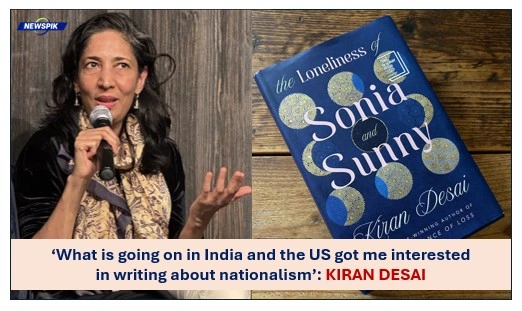

In a time of global flux, with boundaries flaring and identities hardening once more, Booker Prize? winning writer Kiran Desai has brought out a luminous meditation on the state of the world. Desai discussed her most recent novel The Loneliness of Sonia and Sunny in depth at the Kerala Literature Festival in January 2026, a masterpiece about self-inflicted emotional chasms that has just been shortlisted for the 2025 Booker Prize.
The artistic impetus behind her most recent work lay not in abstract theory, Desai said, but the blood-and-guts politics taking place across two countries she calls home: India and the United States. “What’s happening in India and the United States made me want to write about nationalism,” she said, noting a worldwide “entry of fear” that has upended what it means to be an immigrant.
An “Impending Wake-Up Call” for the Indian Diaspora
A noteworthy concept to emerge in Desai’s recent writings is that of the ‘‘lesson in empathy” currently being presented to the Indian diaspora. But for decades, many Indian immigrants in the United States had worked under the belief that they were “favored immigrants,” a privileged class of successful and educated people who were insulated from the more strident currents of xenophobia.
However, as immigration rhetoric in the US has hardened under the current political climate, that sense of security has begun to dissolve. Desai points out a curious contradiction that has long existed within the diaspora:
- The Secular Paradox: Many Indian Americans have been vocal supporters of secular democracy and minority rights in the US, while simultaneously funding and supporting nationalist movements back in India.
- The Empathy Gap: Desai suggests that the current “disconcerting” atmosphere in America serves as a necessary corrective. By experiencing the vulnerability of being a minority in a nationalistic US, she hopes the diaspora will develop a deeper empathy for minorities facing similar pressures in India.
Patriotism vs. The “Demand Towards Whiteness”
In The Loneliness of Sonia and Sunny, Desai examines how nationalism and patriotism can be used as weapons against the individual. For many Indian immigrants, the process of “becoming American” is made as an act of loyalty — and a kind of patriotic duty, she writes — even when it comes with a buried emotional toll that connecting Indians across cultures what Anand has described as the “demand towards whiteness.”
Desai explores the “racial rage” on the part of India during the film, as well as addressing it through Sunny, a New York journalist struggling to make a name for himself.
- The Identity Dilemma: Desai frames a blunt question that haunts her characters: “Am I patriotic if I become more American, or am I patriotic if I am more Indian?”
- Generational Loss: The novel laments, too, the end of an older and principled generation raised in British India. The death of her own father felt, Desai wrote in a subsequent piece, like “losing India,” which he embodied as a secular, synthetically fused anchor that is slowly being replaced by more exclusive formulas of nationhood.
Marjane Satrapi: Writing in defiance of fear
Given that Desai is returning to the subject of nationalism, her new novel can be seen as a radical departure from The Inheritance of Loss (2006). If her earlier novels were haunted by colonialism, the new one is an encounter with the “political, intellectual and historical loneliness” of our time.
She worried at the “entry of fear” into the democracy of things. When people are too frightened to speak or stay at home for fear of confrontation, it’s often the “beginning of the end” for democratic notions, Desai warns.
- The Artist’s Duty: In a world in which journalists and historians are coming more under pressure, Desai feels that writers have a special duty to “leap into the bumbling script” of human secrets and secret histories.
- Global Perspective: She warned against looking at the US or India in isolation. Anti-immigrant rhetoric is an international wave, with migrants around the world feeling profoundly threatened.
The Loneliness of the Contemporary Immigrant
At root, Desai’s exercise is about loneliness and nationalism. In her world, the contemporary immigrant is not merely physically exiled; he is intellectually estranged by a planet that craves reductionist stories.
“Countries want a simple story,” she said. “Precisely that.” By documenting the “moral ambiguity and fluidity” of migration, Desai counteracts these facile reductions. She is pleased with younger, fearless political voices — like Zohran Mamdani in New York City — who have the “supreme confidence” of youth to rally against oppressive policies and advocate for vulnerable communities.
Kiran Desai’s observations are a powerful reminder that nationalism is not only a policy or boundary: It is an emotional force that changes the way we love, family and imagine our place in the world.

A versatile writer mainly works on trending news, daily updates from politics, business, crime, current affairs and entertainment.