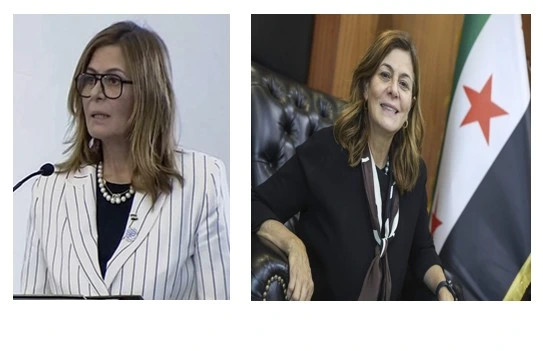

But within the echoes of one of Damascus’s old streets — on which dust from battles is settling slowly into the quiet of a transition that no one wants to call — there is another voice calling with a kind of authority. Hind Kabawat, the Minister of Social Affairs and Labour in Syria’s interim government isn’t just a politician; she is a bridge-builder in a land whose spans has been shattered.
The fact that Kabawat is both the only woman and the only Christian in a 23-member government appointed in March 2025 following the ouster of Assad makes her responsibility go beyond just administrative. She is there for the “reconstruction of the soul” – rebuilding a society where 90% of the population lives below the poverty line, and trust has been a victim of war for over 14 years.
A Government of Experts: Beyond the “Trophy” Nomination
Skeptics waited for signs that President Ahmed al-Sharaa was appointing his cabinet along the same old sectarian lines. But Kabawat has been clear in saying her role is characterized by ability, not simply “who she is. A former international counsel in Toronto who holds a Master’s in Law and Diplomacy from the Fletcher School, she embodies the new generation of Syrian leadership: the “expert-technocrat.”
Her appointment is a strategic message to the international community. By appointing a veteran mediator, human rights activist to head Social Affairs, the transitional government is aiming to shift gears from “identity politics” to “citizenship politics.” For Kabawat, whether she is Christian or female is irrelevant to the overriding goal of working for the Syrian citizen.
The golden fortress: constructing on ‘minus zero’
The most daunting obstacle for Kabawat is the physical and financial ruin in which the country has been left. She frequently refers to the condition of the Syrian economy when she arrived as “minus zero.” The treasury was empty, roads and rails were in ruins, and the country was —and still is — under heavy international sanctions.
The Budget-Expectation Gap
The Minister now has a sense of urgency in 2026. The Syrian people, long oppressed and for a decade at war, have very high expectations of immediate relief. But Kabawat’s ministry runs on a “shoestring” budget.
- The Sanctions Paradox: Although some Western sanctions have been lifted to permit humanitarian aid and reconstruction, the re-entry into global financial systems is slow.
- Salaries and Social Security: It’s a struggle to pay the salaries of government employees or provide for orphans and old people without large-scale foreign investment.
Building the Social Fabric: Soothing the Invisible Wounds
While architects discuss reconstructing bridges and power plants, Hind Kabawat discusses Social Cohesion. She knows a country can have new roads and still be a graveyard if its people are divided by hate.
The Trauma of the Disappeared
The most maternity file on her desk is that of the forcibly disappeared, she said. With more than 100,000 people thought to have disappeared during the war, the Ministry of Social Affairs, in conjunction with commissions on transitional justice is trying to trace missing children and carry out DNA testing.
- Transitional Justice: Kabawat has pointed out that justice delayed is what allows contemporary violence to flare up in places like the coast and Sweida.
- Hate Speech Legislation: Her ministry is working on laws to stem “rampant” hate speech following sectarian violence.
“To choose dialogue is to choose hope. We know what our priorities are: social protection, jobs, and building capabilities.”
The “Lonely” Table: The One for the Lady in a Room of Men
Despite her standing credentials, Kabawat costs up to the only female at the table in cabinet meetings. But this, for her, is not a burden; it’s a mandate. At stake for her in every new board or institution being set up, is to howl for “Gender Quotas”.
Her experience with Tastakel, the organization she established to empower women through education and non-violence, has continued to inform her policy. She is pushing for:
- Vocational education: Targeting explicitly widows and female headed households that are now the sole providers for millions of Syrian homes.
- Legal Reform: Harmonisation of Syrian labour legislation with the international standards for the protection of women in employment.
- Representation: That the “new Syria” is not simply just another men’s transition, but a pluralistic democracy.
The Path Forward: From Refugee to Rebuilder
Kabawat’s journey is personal. Ms. Alloush, who had spent years in exile training Syrian students on how to resolve conflicts from Istanbul and Amman, said her return to Damascus was something of coming full circle. She’s one of the “Syrian Diaspora” returning to put her abilities at the service of a motherland that had all but forgotten them.
Conclusion: The Making of a Legacy
Whether or not Hind Kabawat succeeds, in a very real sense she is the litmus test of success for the Syrian transition itself. If she can create a social safety net out of thin air and open lines of communication between rival groups, she will have done more than simply “held together”—she will have redefined what it means to be Syrian.
Forbes’ Most Powerful Women in 2025 Meet the three Indian trailblazers

A versatile writer mainly works on trending news, daily updates from politics, business, crime, current affairs and entertainment.