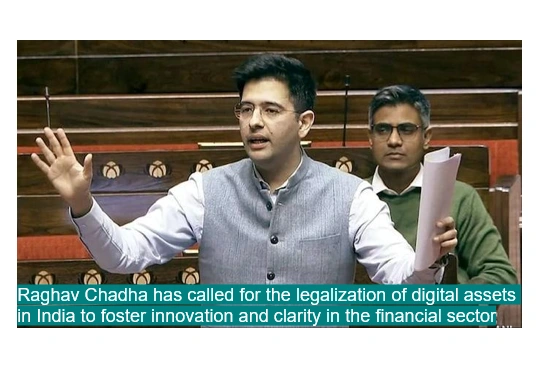

In the current Budget discussions taking place in the Rajya Sabha, Aam Aadmi Party (AAP) MP Raghav Chadha is once again pushing for legal recognition and regulation of digital assets in India, arguing that existing policy is contradictory and negative for both investors and the economy.
Chadha’s remarks have reopened the debate on how virtual digital assets (VDAs), such as cryptocurrencies, stablecoins and tokenized assets, should be treated in India, and whether there needs to be a supportive legal framework providing clarity for VDAs.
Taxed as Legal, Regulated as Illegal – The Fundamental Contradiction
Chadha’s primary critique centers around what he refers to as a policy paradox:
- Currently, India is taxing VDAs (virtual digital assets) with a 30% capital gains tax plus a 1% TDS (tax deduction at source) on crypto transactions – which means that logically, they are treated as a taxable asset.
- However, there is no formal legal recognition within India for VDAs; they do not have any licensing laws applicable to them, investor protections available to them, or any AMU (anti money laundering) regulations that cover VDAs on a domestic basis.
- As Chadha pointed out, “This creates a contradiction, means that India taxes digital assets as if they are legal, but regulates them as if they are illegal”. Furthermore, this regulatory ambiguity negatively affects investor confidence and enforcement.
- Chadha urged the government to formally recognise VDAs as an asset class and to create a proper regulatory regime so that there is no confusion due to excessive taxation.
The Offshore Migration of Capital and Start-ups
Chadha painted a dire picture of the current virtual asset ecosystem in India:
- Approximately 73% of India’s volume of trading in VDAs has moved offshore to other countries.
- Approximately ₹4.8 Lakh Crore in trades have been conducted offshore due to uncertainty in India.
- About 180 Indian crypto start-ups have moved to Jurisdictions such as Dubai and Singapore to get access to a better regulatory structure.
- There are approximately 12 Crore Indian investors now using overseas exchanges to access digital asset markets.
According to Chadha, the above statistics reflect a loss of capital, innovation and tax revenue, as well as a loss of India’s overall leadership in these markets. However, if a strong domestic framework for VDAs were created, it would allow these losses to be reversed.
Potential Revenue to the Government
In addition to the clarity of regulations, Chadha also highlighted the financial opportunity to the government from the legalisation and regulation of all digital assets. By Chadha’s calculations, a robust domestic market and clear regulations could result in an increase of between ₹15,000-20,000 crore per year in additional tax revenue for the government.
He claimed that a domestic regulatory sandbox with appropriate Anti-Money Laundering regulatory oversight would improve compliance while also attracting legitimate investment and businesses into India’s legal system.
Industry support and broader term debate
Chadha’s position has been well-received by industry and crypto participants who have complained for years about the lack of clarity in Indian regulations:
- Industry leaders such as executives at major exchanges and crypto companies have echoed calls for legal recognition and a compliant framework that provides tools to protect investors.
- Industry representatives believe that more and more regulators globally are adopting transparent regulations for crypto assets instead of resisting innovation; therefore, India risks falling behind unless it acts to modernise its approach.
- These voices assert that a balanced policy that provides legal recognition, reasonable taxation, and adequate measurement to protect the public that would retain talent, capital, and technological leadership.
Indian Executive Linked to ‘SaaSpocalypse’ as AI Shock Erases ₹2.5 Lakh Crore
Next Steps ‐ Innovation Vs Caution
Chadha made these remarks during a time when investors in digital assets continue to adopt rapidly, creating significant momentum for greater clarity from the overall ecosystem. However, Chadha may encounter resistance from regulators and policymakers, as they remain cautious regarding systemic risks that may arise from virtual digital assets (VDAs), particularly stablecoins and unbacked tokens.
Currently, legalizing digital assets is up for discussion, with some arguing it would create the right environment for innovation, consumers to have their interests protected, and fiscal responsibility including ensuring the financial system’s stability.
Four points on why this is important
- Protecting investors – Making clear laws provides Indian investors with the same access to courts as any other investor globally and makes them feel confident about their investment.
- Economic impact – Legalizing VDAs may result in increased tax revenues and increased domestic trading by bringing back onshore trading.
- Retaining innovation in India – By establishing clear regulations for VDAs, it may prevent start-ups from leaving India and relocating to other countries.
- Enhance global competitiveness – Legalizing VDAs would establish India as a leader in digital finance through adopting modern policies.
In summary, Raghav Chadha is appealing to Parliament to help bring clarity to India’s digital asset policy by defining digital assets as a legal asset class; to ensure regulatory compliance, protect investors, and reverse capital and innovative outmigration and to promote global commerce.
Raghav Chadha Invites BLinkit Delivery Worker Following Low-Payment Video

A versatile writer mainly works on trending news, daily updates from politics, business, crime, current affairs and entertainment.