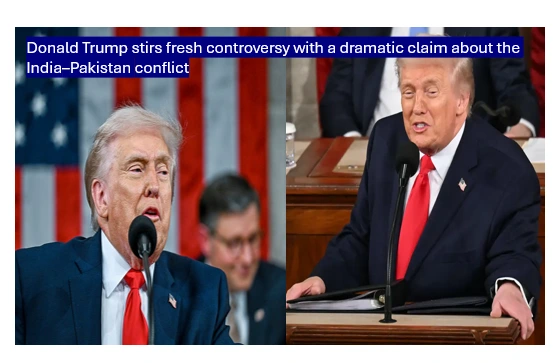

In a classic bold, attention-seeking 2026 State of the Union speech at home, President Donald Trump has thrust himself into both the center and the middle of global stability once again, taking credit for averting nuclear war between India and Pakistan that could have left it with 35 million dead.
The claim, delivered in a joint session of Congress on February 24, 2026, isn’t merely an ordinary campaign-style boast; it is a recapping of the high-stakes military standoff that unfolded in May 2025 and brought the two nuclear-armed neighbors to the precipice of all-out war.
The Claim: “A Saviour of South Asia”
In his speech, Trump explained how he stopped what he called a “bad nuclear war” that was seconds from beginning. Pakistan’s Prime Minister Shehbaz Sharif confirmed the seriousness of the situation, according to the President.
What Trump went on to describe as the weapon of his peace wasn’t traditional diplomacy, but rather his signature tool of economic leverage: tariffs. He said he had called the leaders of both states, warning them that if they did not stop fighting, he would hit all their exports to the United States with a 200 percent tariff.
“I told them, ‘I said, if you’re going to fight, that’s OK, but you’re not doing business with the U.S,’” Trump remembered. “They called and said we have made peace.
What Actually Happened? The 2025 Standoff
To grasp the “35 million” number, you have to go back to what happened in May 2025. The crisis was triggered by a deadly terror attack in Pahalgam in April 2024, which killed 26 civilians. India subsequently launched Operation Sindoor on May 7, 2025 — an orchestrated series of strikes against terror infrastructure across the Line of Control (LoC) and beyond into Pakistani territory.
The escalation was rapid:
- Aerial Dogfights: Trump said in his address that “10 planes were shot down” in the skirmish (a small revision from his previous count of 11).
- The 52-Minute Battle: The engagement lasted around 52 minutes, and early reports describe one of the largest air engagements by numbers in recent history with over 114 combat aircraft taking to the tactical battle space.
- Nuclear Posturing: The militaries of both countries raised their states of alert, raising fear among the international community that the fighting would spill out of conventional arms.
Although Trump takes credit for ending the hostilities on May 10 through his threats of tariffs, the situation on the ground was more complicated. India’s Ministry of External Affairs has consistently claimed that the de-escalation was reached only through bilateral military-to-military communication —in other words, a hotline call between Directors General of Military Operations (DGMOs) and without any third-party mediation.
Read more: Trump border surge drawdown update
Fact-Checking the “35 Million” Figure
Why 35 million, you ask? Where does that number come from? Although Pakistan’s Prime Minister Shehbaz Sharif did reportedly commend Trump at a “Board of Peace” event, branding him a “saviour,” the precise death toll appears to be a Trumpian amplification of the worst-case estimates of nuclear fallout.
India’s Response: A Firm “No”
New Delhi has been unequivocal in its rejection of the Trump narrative. S. Jaishankar, India’s external affairs minister, joked when asked how Trump had contributed to the peace process that while it was being negotiated “the U.S. President was in the U.S.”
India has a long-standing policy of non-mediation, maintaining that all disputes with Pakistan are strictly bilateral in nature under the provisions of the Simla Agreement.
Read more: Rangrez restaurant in London shuts down after receiving Pakistani threats
The Bigger Picture: “Ending Eight Wars”
The India-Pakistan claim was just one episode in Trump’s larger “Board of Peace” narrative. In the same speech, he also asserted that his first 10 months had seen him resolving eight international conflicts, including:
- Israel-Hamas and Israel-Iran
- Serbia and Kosovo
- Armenia and Azerbaijan
- Cambodia and Thailand
By depicting himself as the world’s greatest “closer” of deals, Trump is deploying these foreign policy assertions to reinforce his domestic self-portrait as a strongman able to accomplish through economic coercion what decades of conventional diplomacy could not.
What’s Ahead for South Asian Diplomacy?
Whether the 35 million number is a literal estimate or a rhetorical flourish, it reflects the tenuousness of peace in South Asia. Although a ceasefire has held since May 2025 and commercial flights have resumed, the underlying tensions remain.

A versatile writer mainly works on trending news, daily updates from politics, business, crime, current affairs and entertainment.









