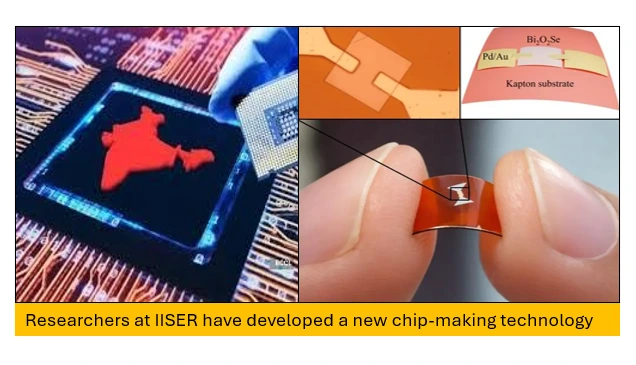

A billion-dollar wall has been a longstanding barrier to entry in any of the high-stakes semiconductor-manufacturing industry. Historically, it has taken enormous clean rooms, toxic chemical baths and lithography machines, costing more than the GDP of small countries, to make the miniature sized chips that run our world. However, in February 2026, researchers at the Indian Institute of Science Education and Research (IISER) have managed to demolish that wall.
In the vanguard is IISER Bhopal, which scientists have announced a breakthrough technology of a so-called indigenous microfabrication. Through their virtual transformation of the art of making chips into the simplicity of using a pen on paper, they are making low-cost, decentralized semiconductor manufacturing in India a reality.
The Pen-and-Paper Breakthrough: The Future of Writing the Future of Silicon
The conventional chip fabrication process depends on photolithography a process in which the circuit pattern is transferred to the silicon wafer through light to a light-sensitive coating known as photoresist. It is precise, however it is also very costly and polluting to the environment.
Dr. Santanu Talukder and his group of the Sixth Sense Lab of IISER in Bhopal resolved to miss this altogether. They are invented with an ultra-sharp metal probe which is used to write circuit patterns directly onto circuit films which are chromium and are nanometre-thin.
How It Works: The Direct-Write Revolution
- The Process: The team employs a spatially confined electrochemical reaction as opposed to light and masks. Imagine it as a miniature form of electronic pen which etches circuits onto the metal.
- No Toxic Waste: The process does not require any hazardous chemicals or the intermediate, so-called resist, layers, which often are industrial wastes.
- Infrastructure-Light: Above all, it eliminates the need of billion-dollar cleanroom facilities, and enables small labs and startups to prototype chips a thousand times cheaper.
The Flexible Frontier: Ultra-Thin Innovation in IISER Pune
Whereas Bhopal is mastering the how of the production process, IISER Pune is mastering the what. On February 20, 2026, scientists at Professor Atikur Rahman stated they had created ultra-thin electronic devices with a new 2D semiconductor material known as Bismuth Oxyselenide.
These sheets are a matter of a few atoms in thickness, many thousands of times the fineness of a human hair, but they have a mechanical strength which their dimensions cannot support. These atom-thin devices were folded and bent thousands of times in the lab and had no loss in electrical performance.
This is the missing link to:
- Smart Fabrics: Clothes which can keep track of your vitals without the huge sensors.
- Foldable Displays: It is not just a foldable screen but can be crumpled and ironed flat like a sheet of paper.
- Wearable Health Monitors: Patches that can be placed on the skin, which monitor glucose or oxygen levels in real-time.
Read also: Trump gives Nvidia green light to sell advanced AI chips to China
Democratizing Research: Why this is Important to India
These IISER breakthroughs are far more important than the lab. Across decades, the Indian researchers had to export their designs to other countries where they were supposed to be fabricated due to the excessive costs of the local infrastructure. This caused a brain drain and dependency on foreign supply chains.
IISER is democratizing microfabrication by coming up with methods of fabrication that are cheap
- Startups: A young entrepreneur in a Tier-2 city can now specifically design a new chip without having to raise a venture capital round just to cover the cost of the mask.
- Academia: Indian engineering colleges have the ability to facilitate direct chip-making training to students, producing a “full stack talent pool to the India Semiconductor Mission 2.0.

A versatile writer mainly works on trending news, daily updates from politics, business, crime, current affairs and entertainment.