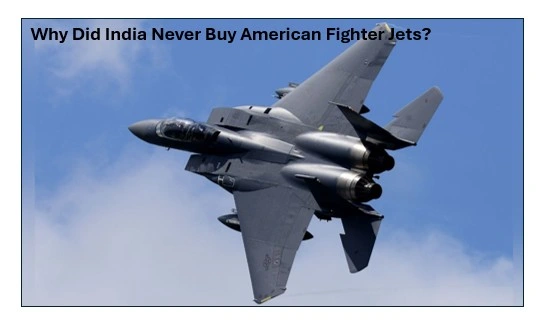

The recent development implies that the historical reasons for India avoiding purchasing US fighter jets (due to Cold War politics, concerns about sanctions, technology sharing disputes and desire for strategic autonomy) are being eclipsed by an expanding bilateral defense cooperation between the United States and India. As geopolitical relations continue to change and evolve, American aircraft could ultimately contribute to India’s future weapon systems development efforts.
1. Cold War Politics: India’s and the United States’ Strategic Mistrust
Following independence from Britain in 1947, India pursued a policy of strategic non-alignment, whilst at the same time, the United States was forming alliances with Pakistan and supplying Pakistan with military aircraft, including both the F-86 Sabre and the F-16 Fighter.
This created a deep-seated mistrust in New Delhi of the United States. India feared that purchasing military aircraft from the United States would create a situation where India’s defense was dependent on a country that supplied arms to India’s main rival – Pakistan. Therefore, after the end of the Cold War, India strengthened its relationship with the Soviet Union and began using Soviet aircraft, including the Mi-21 and the Su-30MKI.
2. Sanctions and Concerns Regarding Reliability
Following India’s detonation of nuclear weapons during the Pokhran-II test series, the United States imposed trade sanctions on India that severely limited United States-India defense cooperation. Consequently, for Indian military planners, the sanctions on India raised serious questions about the reliability of any military platforms purchased from the United States. Conversely, Russia has continued to supply India with military equipment even during politically tense periods, demonstrating to India that Russia will stand by India regardless of the broader political climate within the world.
3. Technology Transfer Disputes
India’s procurement strategy for defense emphasizes both local manufacturing and technology transfer.
American companies have historically been resistant to sharing sensitive technology. The United States offered its fighters to India as part of its MMRCA process in the 2000s, but India ultimately went with the Rafale because France agreed to provide India with more significant,long-term industrial participation.
4. Independent Operations
India prefers to be able to operate from a platform that can independently upgrade or integrate with new weapons.
With most American defense systems, the U.S. government tightly controls the software and integration under U.S. regulations such as ITAR (International Traffic in Arms Regulations) resulting in the Indian defense planners being concerned they would not be able to integrate new indigenous weapons or modify U.S.- supplied systems without U.S. government approval.
Russian and French defense suppliers have historically permitted greater flexibility for Indian requirements.
5. Transforming Dynamics in the 2020s
The dynamic situation is slowly changing with increasing defense cooperation between the U.S. and India through increased number of agreements, joint exercises, the USA and India have been mutually strengthening their defense ties.
India has recently been offered advanced American fighter planes such as the F-21 and F-15EX Eagle II for the future Indian Air Force’s fighter plane programs. Meanwhile, India is working with General Electric to co-develop fighter engine technology for HAL Tejas (the Indian Fighter).

A versatile writer mainly works on trending news, daily updates from politics, business, crime, current affairs and entertainment.