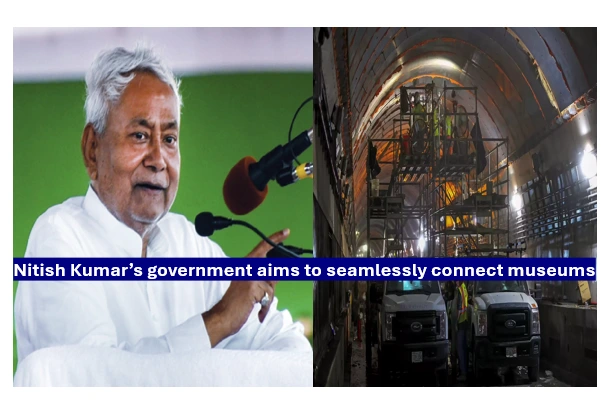

The Bihar government has given the greenlight to a ₹542 crore initiative to build an underground ‘heritage tunnel’ between the Bihar Museum and Patna Museum. The aim of this project, which was approved by the State Cabinet under the administration of Chief Minister Nitish Kumar, is to provide better access to visitors to both of these significant cultural landmarks as well as to bolster heritage tourism in Bihar.
The idea is to create a perfect link between the two museums, allowing everyone to access them easily without having to contend with busy city traffic.
Cultural Tunnel: A First of its Kind, A major heritage infrastructure project
The 1.5 km long underground tunnel will run about 15 to 20 metres deep below some of Patna’s busiest areas and will have a diameter of about eight metres. According to government officials, it is considered one of the first of its kind in India to provide an underground passage between two museums.
The engineering used to construct this structure is very advanced and uses modern safety and surveillance systems to easily and safely move visitors through the tunnel.
Art and Cultural Corridor
The underground tunnel serves not only as a passage, but it is also conceptualized to be a cultural gallery. The interior walls, where possible, will display murals, artefacts and paintings depicting the cultural heritage of the State of Bihar, including traditional Madhubani painting.
The goal of the design for the tunnel is to provide a unique, immersive cultural experience showcasing the artistic heritage and historical legacy of the state through the journey between the two museums.
Read also: Ganga Expressway to boost UP economy
Facilities for the visitors
The tunnel will be fully air conditioned and include many of Today’s modern visitor amenities. Visitors will be able to walk through the corridor of the tunnel or use battery-operated electric carts, making the transport through the tunnel very convenient for them. As part of enhancing the experience for the visitors, there will be lifts, sky stairs, and secure entry/exit check points at both ends to the tunnel.
There will also be buildings constructed on the entry and exit sides of the tunnel that will have multiple underground levels and will provide various facilities, including security checkpoints, lifts, and restrooms for visitors.
Integration with Patna’s Urban Infrastructure
The tunnel will be constructed by the Delhi Metro Railway Corporation (DMRC) and will be constructed with the new Patna Metro facility. There will also be approximately a 29-meter vertical distance below the upper tunnel at one point of the tunnel to prevent any contact between the new metro tunnel and the museum tunnel.
The work being done on the structure of the tunnel is a part of the greater effort by the city to improve their urban infrastructure while still keeping the cultural areas.
Boost to Tourism and Visitor Experience
State officials are optimistic that the tunnel will greatly boost tourism to Patna by providing an easy way for visitors to visit both museum complexes on one trip. Some officials are proposing that a joint ticketing option be created to facilitate tourist access to both museum complexes via the tunnel.
Along with creating a new tourism experience of a unique cultural walk underneath the city, the tunnel will also alleviate surface traffic between the museum complexes.
Construction on the heritage tunnel has begun, with a potential completion date targeted by around 2027. When completed, the heritage tunnel will represent one of India’s most innovative cultural destination connection projects based on state-of-the-art engineering in support of promoting the cultural heritage of the state of Bihar.
If constructed according to plan, the heritage tunnel will likely become an iconic cultural tourism destination and a vital component in establishing Patna as a leading cultural tourism location in India.

A versatile writer mainly works on trending news, daily updates from politics, business, crime, current affairs and entertainment.