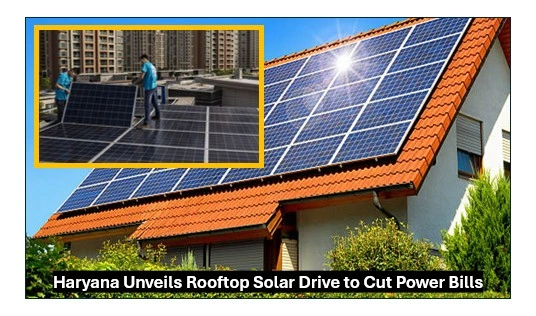

On the sunny roofs of Rohtak, Karnal and Gurugram, a silent revolution is forming. It is not characterized by noisy machineries and ground-level construction work, but by the gradual shimmer of silicon panels in the Haryana sunlight. The Haryana government announced an official Haryanahandi ramp up to its “Rooftop Solar Drive,” a program aimed at changing 2.22 lakh households into mini-power plants by the end of the following fiscal year, on March 10, 2026.
To the middle income family in Hisar or the small scale business owner in Ambala, the reason is easy to understand: the skyrocketing price of traditional electricity. Having made this new push, the state is not merely addressing the issue of green energy, they are addressing the issue of putting the money back into the pockets of its citizens.
The Dream of Zero Bill: Finances That Work
This motor is the PM Surya Ghar: Muft Bijli Yojana that the state of Haryana has incorporated into its own Saur Urja Protsahan Yojana. It is perhaps the most aggressive dual-subsidy model in the country specifically the financial barriers which saw solar as a luxury of the rich man.
According to the existing system, an average 3 kW rooftop system, which can supply power to a typical Indian home with two air conditioners, a refrigerator and several lights, can be eligible to receive a central and state subsidy of up to Rs 1.10 lakh.
Interest-Free financing: Overcoming the Barrier of Upfront Cost
Due to the fact that despite the subsidies, the first deposit may be a barrier, the government of Haryana has launched a buy-now-pay-later type of financial aid program.
- In the case of Non-Defaulting Consumers: A clean track record in relation to bill payments can result in the provision of interest free financial aid of up to Rs 19,500 per kW.
- Repayment through Bills: The repayment is done through the electricity bills of the consumer in 24 installments at easy monthly payments instead of a bank loan which has a high interest charge.
- The Net Effect: The saving obtained by the solar panels are usually better than the monthly payment implying that the system is virtually self-paying.
Government Buildings to Model Solar Villages
It is not restricted to individual terraces. All government buildings such as schools, hospitals and police stations will be completely solar powered by December 2026 according to a mandate issued by Chief Minister, Nayab Singh Saini. This action on its own will save the state exchequer crores of energy spending annually.
The most encouraging one is the Model Solar Village project, perhaps. Each district is being transformed into one village where all solar powered hubs are 24/7. A blueprint has already been made in Balu village, Kaithal with solar-powered streetlights, high-mast lighting, and even solar-powered water pumps to irrigate the land.
Read more: Bengaluru’s ‘white water’ revolution: How apartments are powering
The Human Effect: More Than the Carbon Footprint
There are Haryanvis behind the figures of 1.6 GW cumulative capacity in 2030. To most people, the aspect of installing a rooftop system is a source of pride. It is a symbol of Bijli Atmanirbharta- independence of energy.
Rajesh Kumar, a retired school teacher of Panchkula, was surprised to add to the drive when he wrote that he had been afraid of summer not because of the heat, but because of the 80,000 electricity bill. And now my meter now runs backward in the day with the net-metering system. And I am no longer a consumer, I am a producer.
Also read: Bharat Electricity Summit 2026 – Driving Innovation in the Power Sector
An Automated Electronic Portal
In order to ensure that the project is not stalled in red tape, the state has introduced a digital portal (pmsuryaghar.gov.in). The process is meant to be lightweight in terms of bureaucracy:
- Feasibility Approval: DISCOM officials are required to carry out a technical feasibility study within a stipulated period of time after an application has been received.
- Direct Benefit Transfer (DBT): This is where subsidies are not being mediated by middlemen but when a bank account of the consumer comes into play where subsidies are directly credited within 30 days of commissioning the system.
- Certified Vendors: The government has to use the solar cells that are made in India hence the use of certified vendors is compulsory in the scheme.

I am a versatile content writer from the MP region, covering politics, business, crime, current affairs, entertainment, video games, and sports with clear insights, engaging analysis, and timely, reader-focused updates.









