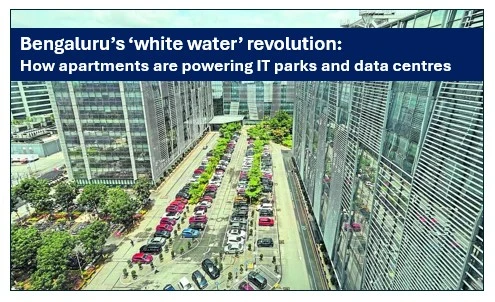

One step below the surface of this city, which has dwelled on the brink of a water catastrophe for years, a quiet revolution is underway amid its many residential complexes. Called the “White Water Revolution,” this movement is transforming Bengaluru’s luxury complexes and middle-class housing societies from being water consumers to water producers that feed the cooling towers of IT parks, server rooms in data centers.
By January 2026, the Bangalore Water Supply and Sewerage Board (BWSSB) and private innovators have connected residential surplus to industrial demand — finally forging a circular economy that could transform the “Silicon Valley of India” into a water-secure city.
From a Drain on the Bank to an Asset: The Apartment Pipeline
For years, Bengaluru’s apartments were mired in a legal and logistical catch-22. On the city’s Zero Liquid Discharge (ZLD) rule, those that had more than 20 units were told to treat sewage within the complex. But only 20–30% of this treated water was used by these colonies for flushing and gardening. The millions of liters that remained increasingly were illegally dumped down storm-water drains because there was no way to move it elsewhere.
Water as a Service (WaaS) The 2026 revelation comes from an evolved “Water-as-a-Service” (WaaS) model. Start-ups such as Boson White Water have linked up with over 3,500 decentralised apartment STPs (Sewage Treatment Plants) to set up sophisticated 11-stage tertiary treatment systems.
- The Process: These units take typical STP water and transform it into “White Water”—extremely pure water that is 70 or fewer ppm of TDS (Total Dissolved Solids) as well as soft (less than 20 ppm of hardness).
- The Economics: there is no upfront cost to the apartments for the equipment. Instead, the service provider runs the filtration and sells either the water to neighboring industries (and sometimes pays a “rent” for the space or a royalty for the water) or both.
- Compliance: It is a solution for the onerous task of dealing with the surplus wastewater in apartments to be in compliance with environmental norms.
Pollution, Flood, Water Crisis: Environmentalist On Top Court’s Aravalli Order
Powering the Digital Giants: Data Centers and IT Parks
The primary beneficiaries of this revolution, however, are also the ones who define Bengaluru’s economy: IT parks and data centers. As Karnataka vies to be India’s “Compute Capital” built on the backs of new data centers hubs in places like Tavarekere and Devanahalli, interest in water has peaked.
Millions of liters of water are needed on a daily basis to cool these data centers that stop servers from overheating. In the past, this used freshwater or high price tankers.
Industrial Synergy: This high-quality ”White Water” from close-by apartments is being feed directly into the cooling towers today. Because of its low mineral content, it is technically better than a borewell water and need less “blowdown” frequency in industrial cooling systems with low chemical consumption.
Impact Scale -Pilot at Kadubeesanahalli STP delivering 70,000 lpd for ORR (Outer Ring Road) IT corridor. Across the city, private aggregators now recycle above 12 lakh litres a day from residential clusters to ensure that the city’s digital heart keeps beating.
Without rivers or lakes, the UAE provides water to millions of people
BWSSB’s Vision: “Water Surplus” Bengaluru By July 2026
The government hasn’t stayed in the wings. BWS SB Chairman Ram Prasath Manohar has tied up these efforts to a city-wide strategy. The board has introduced a One-Time Settlement (OTS) scheme to regularize water billing and is also promoting “nanofiltration” startups to grow by January 2026.
Now the target is set: Bengaluru will become water surplus by July 1, 2026
- Expansion Of Tertiary Treatment: BWSSB, which has large consumers like the Kempegowda International Airport, Rail Wheel Factory and several Global Village tech parks is now providing tertiary treated water of its own.
- Color-Coded Tankers: To avoid a possible mix-up with drinking water, the city has introduced color-coding for tankers that carry treated water — that would otherwise be wasted — to construction sites and industries, to ensure they don’t reach those places in the same tank as potable water.
- Mental Shift: “White Water” is, in fact, “potable water” (drinking quality) but the angle still needs to be towards non-potable and industrial use to escape the cultural image-constraints associated with potty-to-tap.
The “White Water Revolution” is—whether intended or not—a rare win-win for urban planning. It conserves the city’s shrinking groundwater, cuts the cost of doing business for tech giants and turns a waste product into cash for residents.
Sewage in drinking water blamed for at least 10 deaths in India’s ‘cleanest city’

A versatile writer mainly works on trending news, daily updates from politics, business, crime, current affairs and entertainment.