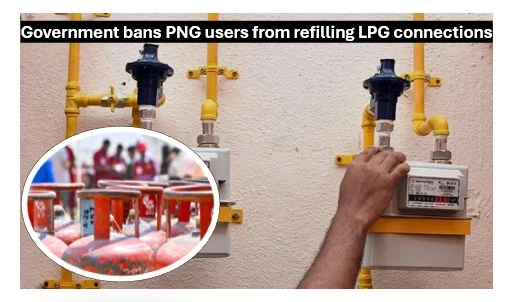

In a major change to its previous policy, the Government of India has prohibited households who receive their supply of piped natural gas (PNG) from obtaining domestic liquefied petroleum gas (LPG) cylinders, or refilling them. The Ministry of Petroleum and Natural Gas issued a press release regarding the ban through an amended supply order which intends to “facilitate better organisation of cooking gas.”
New Rule on Cooking Gas Supply
Under the new regulations, oil marketing companies have been instructed not to issue new LPG connections, nor to refill LPG for consumers who already receive PNG. The change effectively ends the practice of households maintaining both PNG and LPG cooking gas.
Why Did the Government Implement the Ban?
The Government has implemented this ban in order to reduce wastage of resources and duplicate supplies of household energy. Officials believe that when consumers have both LPG and PNG supplies, they cause undue strain on the distribution of cooking gas resources.
By prohibiting households with PNG connections from (also) having access to LPG, the authorities hope to ensure that domestic LPG cylinders are distributed primarily to households who rely solely on them for cooking, particularly in areas where piped gas does not exist, and reduce pressure on LPG networks, thereby enhancing comprehensive energy planning.
Impact of Global Energy Tensions
The new policy announcement has been made amid continued concerns about fuel supply interruptions due to geopolitical tensions in the Middle East. Because India imports a significant portion of its energy resources, including both liquefied natural gas (LNG) and liquefied petroleum gas (LPG), any interruptions in the flow of global supplies could have an impact on domestic supply.
The modification is partly designed as a precautionary measure to provide that there will be sufficient energy supplies for necessary household chores during uncertain times in the global fuel markets. The intent of this change is to optimise the distribution of LPG cylinders so that millions of households can continue receiving the LPG they require.
Instructions for Oil Marketing Companies
The public sector oil companies Indane, Bharat Gas and HP Gas have been instructed, pursuant to this modification, to conduct a re-evaluation of their customer information so they can remove from their records any residential customers who have previously received piped natural gas (PNG) service.
Identified customers will not be able to place orders for additional LPG cylinder refills and will not be allowed to apply for new LPG services. The distributors of LPG have been instructed to strictly enforce this order so as to avoid the improper use of domestic gas supplies.
Also, once authorities identify the customers who have both types of service, those customers may be asked to give up their LPG connection if they currently are receiving piped natural gas.
Also read: BPCL Assures Citizens of Efforts to Ensure Smooth LPG Imports Amid
What It Means for Consumers?
The new regulation primarily targets urban homes that have already been connected to PNG pipelines. In several towns, many families had yesterday also kept extra LPG tanks as a backup to use if the pipeline was not supplying enough.
With this rule, all of the households that currently rely on LPG for cooking will only be able to use piped natural gas (PNG) for all cooking activities. Although PNG has many benefits, such as providing a steady supply of gas without needing to request additional bottles, the removal of the use of LPG one may make some users worried about having enough PNG available while they wait for the repairs to be made (either the attached line in their home or main pipelines in their neighborhood).
Officials have stated that the gas distribution companies serving residents should provide enough PNG to prevent users from experiencing inconveniences.
Read also: India’s LPG Production Increases by 25% Following Government
Pushing For A More Efficient And Cleaner Fuel
In addition, this regulation is considered a part of the government’s overall movement to improve piped gas distribution in cities throughout India. PNG is a significantly cleaner and more efficient cooking fuel source compared to LPG cylinders, plus there are no logistical problems with transporting cylinders and obtaining adequate storage space in homes.
The government wants to promote the complete transition of households that have connections from LPG to PNG when possible. The goal is to create modern energy distribution systems in cities so that LPG can be reserved for those without a source of energy or who live in rural areas.
Read more: LPG Supply Stable Across India as Government Cracks Down on Hoarding
Possible Future Developments
According to experts, this policy may facilitate faster expansion of PNG (pipe natural gas) systems in urban areas and also in newly created residential districts. In addition, authorities must ensure that there is a solid pipe infrastructure in place and that there is reliable gas into homes so as to instill consumer trust.
One other major impact of the amended order is the likely introduction of more measures in order to monitor the distribution of LPG (liquefied petroleum gas) and prevent black market or hoarding during times of uncertainty about supply.
For now though, the amended order constitutes a significant change to India’s domestic cooking gas policy, upholding the commitment “one household, one primary cooking fuel” and improving the distribution of energy through the nation.

I am a versatile content writer from the MP region, covering politics, business, crime, current affairs, entertainment, video games, and sports with clear insights, engaging analysis, and timely, reader-focused updates.