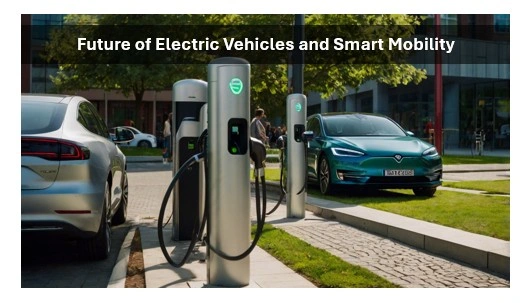

The transportation industry worldwide is changing rapidly as new vehicles are created that do not rely on fossil fuels for their power and mobility. The need for sustainable transportation systems, pollution reduction, and improved urban mobility has led to substantial investment in developing electric vehicles (EVs) and Smart Mobility technologies by governments, automakers, billionaires, and technology companies globally. In the future, mobility is anticipated to be continually electric, connected (embedded in an intelligent infrastructure), autonomous, and shared across all categories of mobility service (e.g., cars, buses, trains, etc).
As countries look for alternatives to fossil fuel-based vehicle systems, there has been a dramatic increase in the demand for Electric Vehicles globally. Rapid progress in battery technology, reduced manufacturing costs, and numerous government incentives have contributed to the accelerating growth of the Electric Vehicle Market.
Recent global growth in EV sales results primarily from government policy support combined with environmental awareness. Governments have implemented various forms of subsidies and tax benefits for EV purchases, as well as more stringent fuel-efficiency standards to promote EV sales. The sustained decline in battery prices combined with the continued expansion of charging networks are expected to make EVs the dominant form of transportation in the next ten years.
Government Policies and Climate Goals
All over the world, countries are putting in place ambitious electric vehicle (EV) policies aimed to end the sale of internal combustion engine vehicles. The European Union plans to ban new sales of gasoline and diesel vehicles by 2035. Likewise, the United Kingdom and Norway have set aggressive goals to rapidly transition to electric mobility.
In India, the government is taking steps like the introduction of the Faster Adoption and Manufacturing of Electric Vehicles (FAME) program to encourage EV adoption and local manufacturing. The country is also working on developing an EV ecosystem by investing in battery production and charging infrastructure.
Increasing Charging Infrastructure
One of the barriers that has made EV adoption difficult has been a lack of charging stations; however, this barrier is being addressed through public and private investment in building out charging networks. Companies such as ChargePoint and Tata Power are working to increase the number of charging stations in cities and along highways.
The speed at which charging technology has improved means that new charging systems can now charge a vehicle to 80 percent in 20 to 30 minutes, therefore reducing range anxiety that many EV drivers once experienced. As charging infrastructure continues to build out, owning an EV will become easier and more practical for the average daily driver.
Read more: Why are electric two-wheelers the backbone of India’s clean mobility future
Smart Mobility and Connected Transport
The future of mobility will be shaped through digital technology in addition to being electrified. Smart mobility encompasses the use of digital technologies, including artificial intelligence (AI), the Internet of Things (IoT), and large datasets known as ‘big data’, to improve existing transportation systems.
As vehicles become connected and able to communicate with one another, as well as with other roadways and infrastructure, this is improving traffic control and decreasing the number of vehicle accidents.
Alphabet Inc. is a tech company that is playing a key role in developing solutions for autonomous vehicles via its Waymo initiative. The emergence of self-driving cars may revolutionise urban mobility and provide a higher level of safety, efficiency, and access to transportation than has existed to date.
Shared & Sustainable Transportation
Smart mobility also encompasses an increased demand for shared transportation systems. Ride-hailing and car-sharing are encouraging consumers to move away from owning cars to more flexible forms of mobility.
Companies such as Uber and Ola are transitioning to electric fleets in an effort to further their sustainability goals. Urban planners are focusing on developing multimodal transportation systems that include public transportation, EVs, bicycles, and walking to create greener and more efficient cities.
Also read: Elon Musk Lauds China’s EV Push, Says Country Is Moving Fast on Clean Energy
Challenges and the Road Ahead
The transition toward electric and intelligent mobility is seeing the rapid advancements of technology, though it will be faced with many obstacles. The high initial costs associated with the purchase of EVs, limited charging infrastructures in many areas and the issue of widely distributed battery recycling are just a few examples of challenges yet to be overcome. In addition, as EVs become more widely adopted, the need for stronger electric grids and alternative fuel supply will also be of major importance.
However, the industry experts remain confident in the idea that there is no turning back from the momentum toward electric and intelligent transportation. With further advancements in technology, increased governmental support through policies and incentives as well as continued development of the necessary infrastructure, EVs and intelligent mobility solutions will play an important role in determining the future of global transportation.

I am a versatile content writer from the MP region, covering politics, business, crime, current affairs, entertainment, video games, and sports with clear insights, engaging analysis, and timely, reader-focused updates.