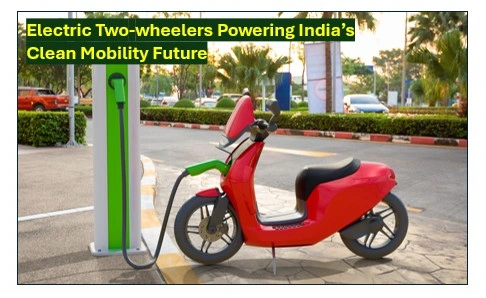

A lot of the news about India’s “clean mobility” focuses on electric cars, giant charging lanes, and billion-dollar battery plants. But that picture doesn’t show how people actually move around every day. The two-wheeler, not the car, is what gets things done on India’s roads. This group already includes more than 70% of all registered cars and more than half of all gasoline sales. If lowering pollution is important, high-end electric cars are not the best place to start. The car that touches the most people makes the most sense as a place to start. So, electric two-wheelers are not a step toward India’s EV shift. They’re the big act.
This change is clear from the market. India registered over 2.02 million electric vehicles in 2025, slightly more than the 1.95 million that were registered in 2024. Electric two-wheelers were a big part of this rise; they accounted for almost 1.2 million cars, more than their total of 1.15 million from the previous year. Ideas or phrases don’t cause this change. It is based on daily business and how things really are on Indian streets.
Life in the City
Small, easy-to-ride, and cheap motorbikes work best on Indian streets. For a long time, two-wheelers have been the only way to get around every day. They make it easy to navigate traffic and park in tight spots. They’re also good for the short trips that most people make every day. Most trips in cities can be done by electric cars, and since you can charge them at home or at work, you don’t have to wait in line at public chargers. Getting electricity also helps with problems that people face every day in cities, like noise and dirty air. The idea that big cars will be the main form of electric transportation doesn’t account for how Indian streets work. Two-wheelers are already used for many things, like getting around on their own, shared rides, and connecting the first and last miles. Switching this level of movement to electric has bigger and faster effects than waiting for cars to become more electric on a large scale.
Elon Musk Lauds China’s EV Push, Says Country Is Moving Fast on Clean Energy
Cost Sense
In India, winners are determined by price, and this is where electric two-wheelers quietly beat out gasoline models. The price of gasoline has risen by about 60% over the last five years, making it more expensive to own an internal combustion two-wheeler. Still, electricity is a lot cheaper per kilometre than gasoline or oil. These savings add up quickly for people who ride every day. Studies show that, based on how it is used, an electric two-wheeler can have a lower total cost of ownership than a gasoline model of the same type. That difference is important when two-wheelers are used for work around the house instead of as fashion statements. Electric cars are no longer expensive gimmicks; they’re now smart financial choices for families, students, and gig workers.
Delivery Business
The rise of door-to-door service has changed how people get around in India’s towns and cities. Food, groceries, and packages are now mostly delivered by two-wheeler teams rather than by cars. The virus sped up that change, and it hasn’t gone back. Electric two-wheelers offer fleet owners stable operating costs, lower maintenance costs, and protection against fluctuations in fuel prices. Logistics companies pick them because they’re good for business, not because they look good on the brand. Two-wheelers also work better in crowded neighbourhoods where cars have trouble getting in and out and stopping. Tests with bike taxis and shared trip models show that electric two-wheelers can make public transportation farther by adding flexible links for the first and last mile.
India’s EV Game-Changer- Simple Energy Unveils 400 km Range Electric Scooter
Proof of Market
Scepticism about electric two-wheelers used to be based on how long they would last and how well they were made, but that time is over. By 2030, sales penetration is expected to go over 80%, and the market is already moving in that direction. Older companies that used to make mostly gas bikes are now putting a lot of effort into making electric bikes. This is important because these companies add to the environment by providing supply lines, service networks, and more ways to get money. When well known brands put money and reputation behind electric two-wheelers, the change seems less like an experiment and more like it has to happen. This is clear from the 2025 numbers. Electric bikes did more than just get bigger. They beat all previous records and became the main reason why EVs became popular.

I am a versatile content writer from the MP region, covering politics, business, crime, current affairs, entertainment, video games, and sports with clear insights, engaging analysis, and timely, reader-focused updates.