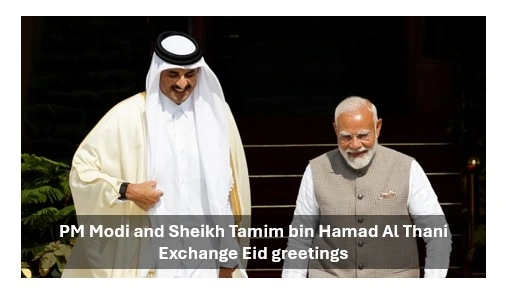

When the golden crescent of the moon starts moving through the sky of West Asia the holy month of Ramadan is finished, another type of the connection was established over the Arabian Sea. Prime minister Narendra Modi called his brother, His Highness Sheikh Tamim bin Hamad Al Thani, the Amir of Qatar, to have a talk that transcended beyond the usual texts in international diplomacy.
In a world that is commonly divided by the geopolitical tension and economic rivalry, the Eid-ul-Fitr greetings between the two leaders was a bitter sweet moment as it reminded people of the human element that binds India-Qatar relationship. But with the fraternal cord we had the fraternal situation; and the situation was that of mutual stronghold and strategic alliances.
Outside the Greeting: A Partnership of Solidarity
The phone call, that happened on the eve of the Eid celebrations in the Gulf, was not a festive ritual. It happened in the context of a considerable turmoil within the region. Over the past few days, tensions in the Middle East have increased enormously, namely, in the form of targeted attacks on vital energy infrastructure, namely, the Ras Laffan Industrial City and a number of LNG plants in Qatar.
Prime minister Modi took the platform to pull a very strong and unequivocal denunciation of such instances of aggression. To India, Qatar is not only a diplomatic partner, but a lifeline of energy.
Read more: Welcome My Brother’: PM Modi Receives UAE President on Arrival in India
The Human Bridge: 800,000 Tales of Interconnection
The Indian community in Qatar is its soul, provided that energy is the main element of the relationship. The most humanizing element of the discussion was the thanksgiving that the Prime Minister gave to the Amir due to the care and support that had been given to the almost 800,000 Indians living and working in the peninsula.
The Indian diaspora is the biggest group of expatriates in Qatar, whether they are the engineers assisting in the construction of the futuristic skyline in Doha, or the healthcare personnel in the hospitals there. In the call, PM Modi was able to appreciate the fact that despite regional insecurity issues, the security and welfare of such citizens have continued to be part of the Qatari leadership agenda.
Also read: Modi Welcomes Dear Friend Macron as India France Partnership Enters
Going Round the Bend: Trade and the Strait of Hormuz
As the Eid-dipped conversation went, the meat of the discussion was its strategy, which focused on the future. Both leaders confirmed a common position on a serious international problem safe and free navigation through the Strait of Hormuz.
India is also a middle power and an emerging global economy, which is speaking increasingly on the subject of maritime security. As the conflict in the West Asia heightens its risk of spreading over to essential shipping routes, the agreement between Modi and Al Thani to remain open to the waters is a crucial message to the international community.
This call also comes at a crucial time when the next round of India-Qatar Free Trade Agreement is to be finalized, and this is expected to happen by mid-2026. The target is high: to increase bilateral trade to 30 billion dollars by 2030, which is twice the current amount of the trade, i.e. $14 billion. The two leaders are setting the stage of a giant economic growth that will have a positive impact on tech startups in Bengaluru and energy companies in both Doha and Bengaluru by helping restore political confidence in the midst of a crisis.

A versatile writer mainly works on trending news, daily updates from politics, business, crime, current affairs and entertainment.