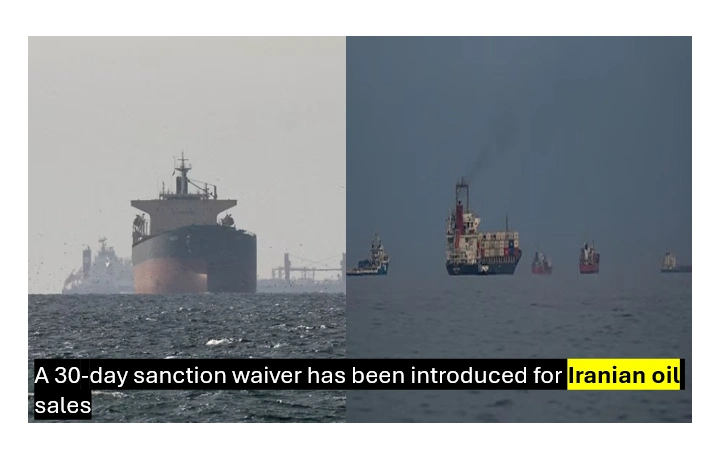

The U.S. issued a temporary 30-day sanctions waiver for limited transactions involving Iranian crude, marking a change in its enforcement position towards Iran. The waiver is conditioned on being used only by specific countries and entities that are already negotiating compliant transactions with U.S. authorities. The waiver is viewed as a short-term option designed to provide flexibility rather than reflect a long-term policy shift.
Additionally, the waiver permits certain buyers to purchase Iranian oil while offering no immediate sanctions penalties for any buyer who engages in such sales. In this context, the strategic and economic landscape has changed due to supply disruptions, fluctuating oil prices, and geopolitical instability that cause the U.S. government to balance its goals of economic stability with other foreign policy objectives.
Allowing limited Iranian oil to be exported could help stabilize supply and ease price pressures, especially for nations that are reliant on imports of crude oil. Analysts also believe this may be part of a larger strategy to keep cooperation and solidarity with major allies experiencing challenges to their energy security.
The waiver also demonstrates the difficulties faced in restricting these types of transactions in a global marketplace where oil flows may occur through many different sources and intermediaries and where it can be very difficult to track them.
Impacts on Iran
Despite being allowed to export a limited amount of oil under the temporary waiver, Iran will see some improvements to its economic conditions. Oil has always been directly correlated with revenues for Iran, who have been economically disadvantaged for several years due to the effects of international sanctions.
However, many believe the 30-day duration of the waiver will not provide sufficient time for Iran to make any meaningful changes to its economic condition. More likely, the waiver will serve as a diplomatic signal (potentially positive and/or negative) regarding enhancing or leveraging negotiations with Iran for present and/or future negotiations.
Potential for Diplomatic Use
One potential utilization of the waiver could be as part of a larger diplomatic strategy intended to facilitate the resolution of the current stagnation regarding Iran’s nuclear capability. At this point, there have not been any public announcements linking the issuance of the waiver to negotiations; however, it is common to utilize changes in policy to facilitate a dialogue.
The history of relations between the United States and Iran has been punctuated by ongoing tensions and the primary tool used to apply pressure on Iran has been to impose sanctions. By offering a limited and temporary suspension of sanctions, one could expect there is some willingness to explore incremental progress toward resolution through smaller and/or multiple agreements rather than seeking to establish one large, all-encompassing agreement.
Concerns and Criticism
Opinions regarding the easing of U.S. sanctions have been largely divided. Opponents worry that if the U.S. offers Iran any leniency in enforcing sanctions, even temporarily, it might weaken the overall impact of sanctions on Iran and could give Iran additional incentive to continue their current course of action without having made any major concessions.
Supporters argue that if the U.S. were to continue to strictly enforce sanctions, without exception, it would be damaging to U.S. alliances in the region and would not achieve the intended objectives. They believe that granting the waiver is simply a logical adaptation on the part of the U.S. to changing conditions in the real world.
Read also: Iran hits the biggest oil refinery complex in UAE
What Happens Next?
The key issue going forward will be whether the U.S. continues the waiver beyond the 30-day expiration date, expands it, or allows it to expire. Developments in the geopolitical arena, the energy marketplace, and the direction of the future of U.S.-Iranian relations will largely dictate how the waiver is resolved.
Overall, the initial 30-day waiver represents a tactical pause in U.S.-Iran relations, not a major restructuring; it also highlights the difficulty in balancing economic realities with the United States foreign policy goals.

A versatile writer mainly works on trending news, daily updates from politics, business, crime, current affairs and entertainment.









