
Over the decades, when people thought about rural India, they tended to see only one object of an incredibly harsh ritual: a procession of women, balancing a load of brass or plastic pots on their heads and walking kilometers in the scorching sun to a drying well or a cloudy pond. It was a cycle that determined the pace of life, consumed hours of productive time and often jeopardized the health of the most vulnerable one.
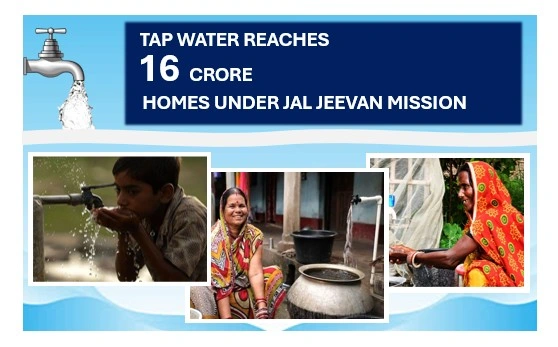
The disappearance of that landscape is today experiencing a silent tectonic transformation. Recently, the Union Minister C. R. Patil announced a landmark to this change which is a milestone itself, the Jal Jeevan Mission (JJM) has already achieved success in connection of tap water to more than 16 crore (160 Million) households nationwide.
Water Scarcity to Water Sovereignty
At the time of the opening of the Jal Jeevan Mission on August 2019, only approximately 3.23 crore rural households had tap water. It was a steep mountain to climb. This was a bold target: to install Functional Household Tap Connections (FHTC) in every rural household by 2024 (a deadline that was later modified and scaled up because of the sheer size of the targets to be met in 2026).
The Human Face of 16 Crore Taps
One need not go farther than the notes given by the Union Minister to appreciate the weight of this accomplishment, one has to step into the lives of people such as Sunita Devi who lives in a small hamlet in Bundelkhand.
Marvel Behind the Scenes Engineer
The system of delivering water to 16 crore households in an extremely diverse geography like India is an engineering marvel that intersects with the largest infrastructural undertakings in the world. It does not simply mean laying pipes but going through the Himalayas and the sands of Rajasthan and through the forests of the Northeast.
Robust Infrastructure
- The mission is associated with a complicated set of:
- Village level infrastructure: Gravity systems, solar-powered pumps and overhead tanks.
- Source Sustainability: Making sure that the water source does not become dry due to water harvesting and groundwater recharge using rainwater.
- Treatment Plants: It is important to ensure that it is not only available, but potable.
Read more: Indore water contamination : Supply of water in municipal taps restricted
The “Har Ghar Jal” States
Various states and Union Territories have already attained 100 percent saturation such as Goa, Telangana, Haryana, Gujarat and Punjab. The centre of attention has now become furious to the so-called aspirational districts and Japanese Encephalitis-Acute Encephalitis Syndrome (JE-AES) affected regions where clean water has become the main vaccine against disease.
The Pulse of a Nation:
The Jal Jeevan Mission rings quite a long way farther out of the kitchen. It is a growth stimulator with multiple sectors.
A Shield Against Disease
Rural India has suffered waterborne diseases such as cholera, dysentery and typhoid diseases that result into high infants mortality rates and high out-of-pocket medical expenses. Since the implementation of the Nal Se Jal program, these illnesses have been recorded to reduce. This is because the government is helping to bring down the burden of healthcare in the country by making drinking water safe.
Empowerment and Employment
It is also a giant employment maker. The project will be required in each village:
- Plumbers and Electricians: The systems are being trained to local youth.
- Water Quality Testing: More than 23 lakh women have been trained to put the Field Test Kits (FTKs) into use to check the water quality.
Read also: Haryana unveils rooftop solar drive to cut power bills
The Dilemma of Sustainability
Union Minister C. R. Patil stressed on the fact that it is a milestone to reach 16 crore homes but the story does not begin and end at tap. The second stage of the mission is the sustainability and greywater management.
The greater the influx of water into houses, the greater the amount of wastewater out of them. The government is also combining the Jal Jeevan Mission with Swachh Bharat Mission (Grameen) to make sure that the wastewater would be treated and reused to be used either in agriculture or industries and not allow the formation of stagnant pools which would serve as breeding areas to mosquitoes.

I am a versatile content writer from the MP region, covering politics, business, crime, current affairs, entertainment, video games, and sports with clear insights, engaging analysis, and timely, reader-focused updates.