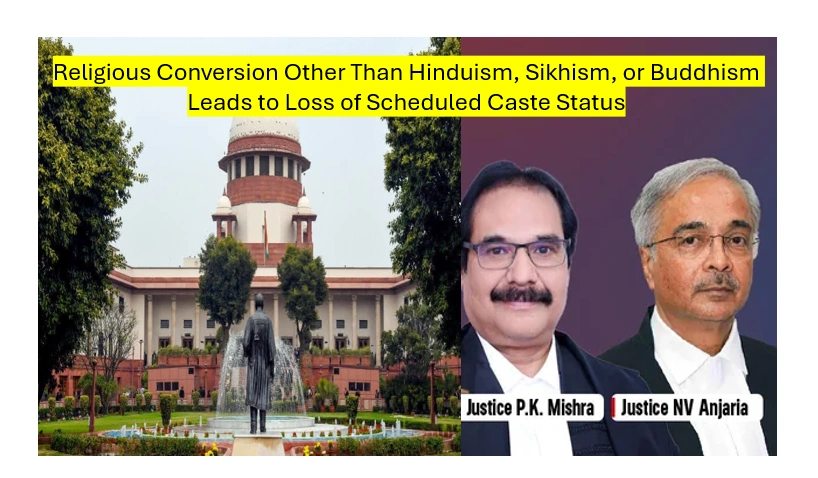

In a historic ruling, India’s Supreme Court recently answered a long-discussed issue: does a person who belongs to an official Scheduled Caste (SC) classification lose that classification when converting from religions like Hinduism, Sikhism, or Buddhism to another religion? For decades, people have debated this issue with respect to SC’s eligibility for reservations/benefits and the protections provided by the Constitution.
Constitutional Framework
The Court looked at the provisions of the Constitution (Scheduled Castes) Order of 1950 (originally restricting SC’s classification to only those who are Hindus) and saw that Sikhism (1956) and Buddhism (1990) were later included in SC. The purpose of these provisions within the Constitution was to help remedy the discrimination endured by people classified as belonging to SC based on caste in India’s historical social structure.
Additionally, the Bench reiterated that the legal recognition of SC is a dual system of formal/informal recognition, which is fundamentally dependent upon SC being members of either Hindu, Sikh or Buddhist religions because, from a historical perspective, the legal definitions of caste disabilities have always been linked to the caste system.
Read also: Supreme Court rejects menstrual leave plea
Court’s Key Observation
In light of the above findings, the Supreme Court ruled that persons who have converted to a religion of Islam, Christianity etc. do not continue to have Scheduled Caste (“SC”) status under the current law. Furthermore, the Supreme Court held via legal interpretation that conversion to either of the above religions severed the nexus the converted person had with the caste system created by the religions of Hinduism, Sikhism and Buddhism.
While the Supreme Court noted that individuals may experience discrimination on a social level after conversion (and that is stated by many in the media), and there is an expectation that such discrimination will continue; any amendments to the existing legal framework regarding SC and OBC must be done via legislative/executive action and not through judicial re-interpretation of current laws.
Implications of the Reservations Benefits
With respect to persons benefitting from reservations under the SC reservations based on religion, the Supreme Court stated that only those persons who are classified as Hindus, Sikhs or Buddhists are entitled to claim and receive SC reservation benefits/training etc. Those persons who convert to other religions such as Islam or Christianity will not be entitled to receive SC reservation benefits/training but rather will be provided such benefits/training based on State/OBC classifications from a government agency.
The ongoing petitions for equal treatment for Dalit converts from Christianity and Islam will also have ramifications due to the fact that many people assert that there continues to be discrimination against Dalit converts even after the change in religion.
Read also: Supreme Court Bans NCERT Class 8 Chapter Mentioning Judicial Corruption
Continued Debates and Demands
The issue of caste-based discrimination is politically and socially volatile, and there is a broad-based coalition of advocacy group seeking a review of the Presidential Order passed in 1950. Their argument is that caste-based discrimination is not eliminated as a result of religious conversion, and that Dalits should have equal rights to reservations for protection.
On the other hand, there are stakeholders that advocate that establishing one nation under Scheduled Caste (SC) status will diminish the intent of the original purpose of providing reservations and that the establishment of a single SC identification process for SC will complicate the identification process.
Next Steps
The Supreme Court has ruled that it cannot change the definition of what constitutes a SC relative to what is currently provided under the law. The Court has indicated that it will only agree to review the definition of SC if a request for this to Parliament or the federal government is made!

A versatile writer mainly works on trending news, daily updates from politics, business, crime, current affairs and entertainment.