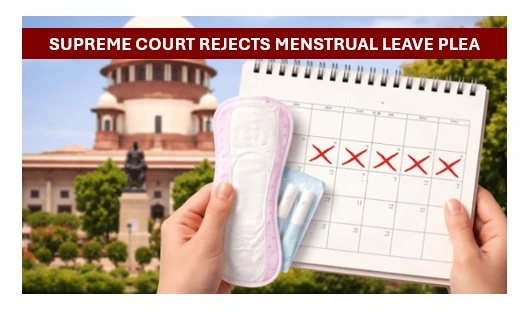

The Supreme Court of India rejected a Public Interest Litigation (PIL) on Friday that called for the development of a national policy requiring menstrual leave for female students and employees in all educational institutions and workplaces. The court expressed that a law mandating menstrual leave may adversely impact women’s employment opportunities and further entrench gender stereotypes, rather than achieving gender equality.
The Supreme Court made its ruling after hearing arguments presented by Chief Justice of India, who stated that although menstrual health is of very high importance, legislating or mandating menstrual leave could have unforeseen implications on the work environment.
The Petition Requested that the Court Direct the Government to Create a Uniform National Policy for Mandatory Menstrual Leave for Women in All Workplaces and Educational Institutions in a manner preserving women’s dignity. The petition claimed that menstruation is a normal natural biological process and that women experience significant discomfort and/or other health problems as a result of their periods.
The petitioner contended that the lack of supportive policies could cause many women to seek work or attend school while experiencing pain; therefore having menstrual leave policies in place would create dignity, health, and gender-sensitive working conditions for women to the end that women become self-sufficient.
Proponents of the petition said men’s monthly leave would combat the negative perception of menstruation while allowing for both sick leave and casual leave without exhausting them due to regular occurrences.
Menstrual Leave and Courts Concerns with Mandatory Leave
Despite their arguments, the supreme court has refused to consider their request to mandate menstrual leave through law as there would be many other issues related to mandating a monthly leave for women.
The bench considered that by mandating a law to provide a monthly leave only for women, employers would tend to view female workers as less productive than male workers.
The judges considered that mandating any kind of leave for women may increase the perception that women are less capable than men, reinforcing workplace discrimination and adversely affecting the career opportunities of women.
Creating awareness and building a gender-sensitive working environment is important, but to mandate a separate monthly leave for women is not the best way to promote equality at work.
Read more: Supreme Court Bans NCERT Class 8 Chapter Mentioning Judicial Corruption
Policy Decisions Should Be Taken by Government
The Court clarified that matters of this kind are best handled through governmental and legislative processes – not through court proceedings. It was suggested that adequate research by the proper authorities could investigate the potential for establishing a scheme for menstrual leave after consulting with interested stakeholders.
Various states and institutions have been able to formulate their own respective policies around menstrual leave based on the nature of their community needs or available resources. Some communities have already successfully implemented voluntary menstrual leave, therefore showing that solutions are possible through administrative processes instead of through judicial orders.
By refraining from making a ruling on this area, the Court allows government officials and private sector employers to establish their own processes to address the established need for access to menstrual leave for both public and private sectors.
Ongoing Debate Over Menstrual Leave
Menstrual Leave remains a topic of debate among both supporters and detractors in India and worldwide; supporters believe that establishing a work-related leave for a woman’s period acknowledges biological realities, is a step toward creating an inclusive workplace, whereas detractors believe that menstrual leave may reinforce cultural gender stereotypes and thereby create additional barriers for women seeking jobs/careers.
Some Indian states and many individual institutions (such as Universities and other Colleges) have piloted menstrual leave policies (i.e., some places provide limited menstrual leave to their female students/staff). There is no national menstrual leave policy across India.
Many experts believe that instead of creating a mandatory menstrual leave policy, workplaces may want to create flexible working hours, allow for telecommuting, and/or improve the health support systems available to cover any potential menstrual health issues.
Read also: 19 year old student argues in Supreme Court for his MBBS seat
Final Conclusion
By rejecting the PIL filed in relation to menstrual leave, the courts are demonstrating how to find a balance between implementing gender-specific policies vs. ensuring workplace equality. While the Court recognized that menstrual health is important, they also indicated that a potential national policy mandating menstrual leave across India may have adverse/unforeseen effects on females’ (women’s) ability to find work.
Overall, the Courts’ ruling leaves the subject matter of menstrual leave policy open to further discussion amongst policymakers, employers and society as a whole; therefore, the debate over menstrual leave in India is ongoing.

I am a versatile content writer from the MP region, covering politics, business, crime, current affairs, entertainment, video games, and sports with clear insights, engaging analysis, and timely, reader-focused updates.









