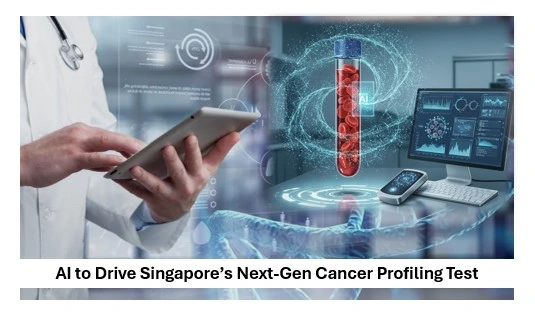

A silent revolution is occurring in the sterile and well-lit laboratories at the National Cancer Centre Singapore (NCCS). It does not include the rattling of machinery and the brassy smell of antiseptic, but instead the silence and lightning speed of artificial intelligence. This week has been the most significant advancement in the healthcare of the nation with researchers officially transitioning into the clinical validation stage of UNITED 2.0, a next-generation cancer profiling test that has the potential to change the dynamic in the ongoing war against one of the most intractable enemies of humanity.
It seemed to take decades before a cancer diagnosis could be perceived to be the completion of a giant puzzle with half of the puzzle pieces missing. Physicians used sniper shots of genes, i.e. examinations of a small number of suspects. Cancer is a change agent; it mutates, conceals and develops. It is now a S$6 million partnership between precision oncology company Lucence, ASTAR Diagnostics Development Hub (DxD Hub) and the NCCS that offers the entire picture.
Going Beyond the Snapshot: The Two-Engine Plane
The core of this new diagnosis is that it is not a mere simple sequencing but a dual approach, as it is referred to by scientists. UNITED 2.0 does not necessarily examine one or two genes; it uses Whole Exome Sequencing (WES) and Whole Transcriptome Sequencing (WTS).
To simplify it, when there is a standard test that is a photograph of a suspect, this new profiling is a high end, 360 degree video of the whole crime scene. The test is able to detect complex mutations and fusions, two groups of mutations that falsely fuse two genes together to promote the growth of a tumor by analyzing both the DNA (the blueprint) and RNA (the messenger).
But this tremendous increase in data introduces a new challenge: it has become too much information that a human mind may take weeks to digest.
Read more: 100 Days of Noland Arbaugh as the First Neuralink Innovator in the World
Artificial Intelligence Interpreter: Data to Decision
The artificial intelligence that is incorporated in the new profiling test in Singapore is a master interpreter. It will process billions of data points in seconds to indicate the exact genetic changes that can be precisely targeted by a clinician using current medications.
We are transforming millions of complicated data points into concise and direct responses by uniting AI with complete DNA and RNA sequencing, says Dr. Tan Min-Han, Founding CEO of Lucence. It assists clinicians to make more appropriate decisions in less time.
This is not merely a convenience, in the case of a patient who has an aggressive Central Nervous System (CNS) tumor or late-stage lung cancer, a week-saving in the lab can translate into a month of life-saving. The AI does not simply identify the mutation, but assists in aligning the patient to the most efficient precision-therapy, which essentially puts an end to the days when oncology was characterized by trial-and-error.
Read also: MIT’s Silent Sense – New Wearable Lets People Communicate Without Speaking
Searching after the “Ghosts Cells: Minimal Residual Disease
Probably the most humanizing thing about this technology is the fact that it displays the response to the question that lingers in the mind of every cancer survivor: is it really gone?
The cooperation is in the process of polishing Minimal Residual Disease (MRD) testing tools. Cancer cells, the presence of which is too insignificant to be detected in a conventional PET or CT scan, may still be in the bloodstream, even after a successful operation or severe series of chemotherapy.

I am a versatile content writer from the MP region, covering politics, business, crime, current affairs, entertainment, video games, and sports with clear insights, engaging analysis, and timely, reader-focused updates.