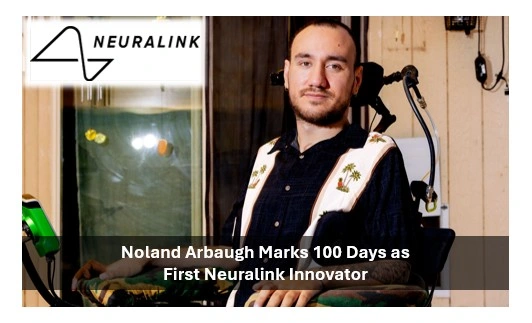

During one of the silent moments in a Sunday afternoon, Noland Arbaugh performs an act which was scientifically impossible to him only four months earlier. He is playing a civilized game. He is not playing on a special joystick, a mouth-controlled stylus, or a voice-recognition package. He is using his mind.
Noland is a 30-year-old who was paralyzed at the shoulder in an accident he suffered nine years ago during a diving competition and officially reached the 100-day mark of receiving Elon Musk’s Neuralink brain-computer interface (BCI) chip, the “Link,” the first human to have the chip implanted. It is not merely a conquest of silicon and fibers; it is a great re-discovery of independence.
The Telepathy Milestone: New Type of Freedom
When Neuralink initially provided news about the successful implantation of N1 sensor, the world viewed it with both fascination and distrust. We got a video of Noland playing the chess using a cursor that he moved over a screen (which he jokingly likened to playing with The Force). But with the 100-day update, one can read a much deeper story than a viral video.
Breaking the Speed Barrier
The technical statistics are appalling. Noland has achieved a rate of bits per second (BPS) that is comparable to the speed of an individual who uses a physical mouse. He has taken hours of practice in aim-training, to learn how to precisely aim his clicks and work in complicated software interfaces.
Read also: Brain–computer interfaces: where science ends and sci-fi begins
How to cope with the Glitches: The Reality of Being Version 1.0
Few successful medical historical figures are an easy climb to the top. The 100-day update did not only celebrate the victories, but it gave a clear view of the mechanical difficulties of state-of-the-art neurotechnology.
Some weeks after the trial, Neuralink engineers have realized that the BPS rate has reduced. The cause? One effect is referred to as thread retraction. Several of the microscopic, hair-thin fibers which link the chip to the motor cortex had literally pulled back on the brain tissue.
Engaging with the Biology of the Engineer
This may have been a stop-work event in most clinical trials. Nevertheless, Noland combined with the Neuralink engineering team made it a breakthrough.
- Algorithms Refinement: The team also reduced the recording algorithm to be more sensitive to the remaining threads instead of having a second surgery.
- Signal Amplification: They enhanced methods of interpreting neural signals to move cursors, in effect doing more with less.
Amazingly, even after the retraction of some threads, the performance of Noland even improved compared to his original speeds following the software update. It turned out to be a crucial thesis: the learning capacity in the software is as crucial as the hearing capacity in the hardware could listen to the brain.
Read more: An interesting device in Deepinder Goyal’s Temple causes a stir online
A Day in the Life: Gaming to Connection
So what does being linked take up? 100 days. To Noland, it will be the cessation of the 9-to-5 of being a patient and the beginning of participation in life.
The Marathon Gaming Sessions
Noland has developed a passion towards Mario Kart 8 and Civilization VI. The fact that the Interface can be manipulated by him without causing any physical inconvenience (and this is the reason) has seen him pull all-nighters playing with friends, which physically tired him and technically involved the use of quite cumbersome technology when using his old assistive devices.
Digital Independence
In addition to gaming, he is able to use the chip to navigate the internet and send mails and do all other social media tasks on his own. To someone who has suffered quadriplegia, the fact that he has a personal online existence, where he does not have to view every message or make every click as a caregiver, is a psychological victory that is beyond quantification.
Training the Future
Noland also uses a considerable amount of his time to provide data to the Neuralink team. Each of his thoughts converted into a movement assists in perfecting the AI models that will one day drive the device on behalf of thousands of people. He is not a patient, he is one of the co-creators of the future.
I am a versatile content writer from the MP region, covering politics, business, crime, current affairs, entertainment, video games, and sports with clear insights, engaging analysis, and timely, reader-focused updates.