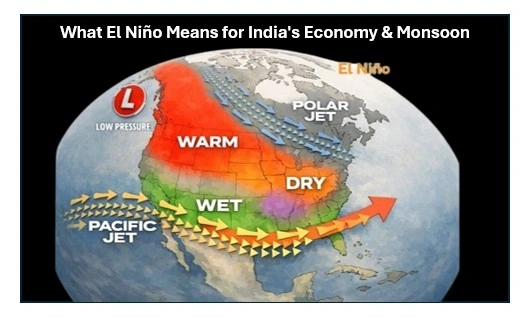

El Niño is a global phenomenon characterised by elevated ocean temperatures in the Pacific Ocean that result in disruptions to the established global weather pattern. In India, the phenomenon is largely associated with weaker southwest monsoons which lead to drought conditions in India (but not every year when El Niño occurs has resulted in drought).
Impact on the 2026 Monsoon Across India
There is a high likelihood that below-average rainfall will negatively impact India’s 2026 monsoon. Recent models have been increasingly indicating between a 60% and 62% chance of El Niño developing during or near the period of the Indian monsoon. Since 1980 out of 14 known El Niño years, nine of these years resulted in below-average Indian monsoons.
During the second half of the monsoon, from August through September, below-average rainfall is highly likely during any given El Niño year. Some research has shown instances where the rainfall during the monsoon was less than anticipated; however, every El Niño year’s monsoon has not been a total washout.
Typical weather patterns during El Niño years are as follows:
- Higher temperatures during the summer months are more frequent.
- Delayed and erratic onset of rainfall.
- Significantly larger year-to-year variations in weather.
Are there conditions in place that might mitigate some of these concerns?
Yes, two of the major contributing factors to this concern are:
- A positive Indian Ocean Dipole (IOD) might have a limited beneficial impact on monsoon improvement.
- There may be significant uncertainty about future rainfall due to the “spring forecasting barrier.”
The final conclusion is that neither a weak nor moderate El Niño appear to present a major threat to the monsoon season; however, both have the potential to adversely affect future agriculture through the long-term drought impact of both scenarios on crop yields.
What will the economic consequences be for India?
1. Agriculture and the rural economy
A large percentage of India’s agricultural economy is based on successful precipitation distribution from the monsoon season. Poor precipitation distribution during the monsoon will lead to lower crop yields, as will rice, pulses, and sugarcane.
Widespread problems in agriculture will be reflected in the rural economy through lower farmland income/output, which will result in declining farm income that ultimately will negatively affect rural demand.
2. Inflation and food prices
Reduced agricultural yields may result in:
- Higher food inflation
- Higher prices on staple crops, such as grains and vegetables.
- Worldwide El Niños may also shorten the availability of agricultural commodities and, consequently, prices.
- Water and energy shortage stressors.
The above-mentioned items would be present in:
- Water scarcity from reservoirs and groundwater
- Increased demand for electricity (for irrigation, cooling etc.)
- Strain on urban drinking and irrigation systems
Read also: IMD forecasts dense fog Conditions over Himachal Pradesh
GDP growth risks:
A poor monsoon season would lead to:
- Lower rural consumption
- Affecting GDP overall (as agriculture supports a large portion of the population)
- Increased governmental expenditures on drought assistance
Sectoral winners and losers:
Potential losers:
- Agriculture and related industries
- Food processing
Potential winners:
- Energy supply companies (due to a higher demand)
- Cooling appliance manufacturing (due to higher demand)
- Government and policy response mechanisms
Read more: IMD Issues Orange Warning for Severe Heat Wave in Gujarat
Typical preparations by the government include:
- Water conservation and irrigation planning
- Management of food reserves
- Monitoring food inflation and rural distress
Advanced warnings allow for preparations in sectors of agriculture, health and energy.
Concluding statement: El Niño brings with it a large risk to the 2026 Indian monsoon and economy. El Niño by itself won’t guarantee a drought; however, the presence of El Niño will increase the likelihood of below-average rainfall, higher than average temperature, and pressure on the economy, in rural areas. The total impact will be influenced by the intensity of the El Niño and other climate variables, particularly in relation to the IOD.

I am a versatile content writer from the MP region, covering politics, business, crime, current affairs, entertainment, video games, and sports with clear insights, engaging analysis, and timely, reader-focused updates.









