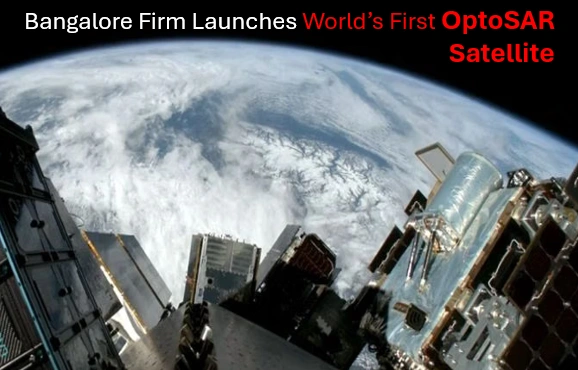

GalaxEye Space, a new company, has one question about world satellite imagery: Why do we have to choose between clear and consistent satellite data?
GalaxEye Space, a company based in Bengaluru, made history on Sunday when it launched Mission Drishti, the world’s first OptoSAR image satellite, on SpaceX’s Falcon 9 rocket from California. The new satellite will offer a better way to observe the Earth by mixing visual images with the more common synthetic aperture radar, or SAR.
With a weight of 190 kg, Mission Drishti is the biggest satellite ever launched by India’s private sector and GalaxEye’s first trip into space. It can take pictures in all kinds of weather and at night or day. It will likely be used for defense, farming, emergency management, and even marine tracking. No matter that it was launched at 12:30 p.m. on May 3, the satellite won’t start sending pictures for a few weeks.
The launch is also the first in a series that the startup plans to do over the next five years. Their goal is to put a fleet of OptoSAR satellites into space to improve their ability to observe the earth.
“Mission Drishti is a big step forward in our journey into space.” “The launch of the world’s first OptoSAR satellite…shows how passionate our young people are about new ideas and building the country,” Prime Minister Narendra Modi wrote on X.
Five master’s engineering students at IIT Madras started GalaxEye Space in 2021
They were led by Suyash Singh, who used to work in the aviation engineering department. Working on Mission Drishti for five years, the company that takes pictures from space of the earth has been in focus.
“The world needs eyes in the sky that are faster, sharper, and more persistent right now.” “Our satellite is a big step forward in getting richer, more detailed analytical intelligence,” Singh, co-founder and CEO of GalaxEye, said in a news release. “Its improved resolution and performance make it possible.”
“Why must we choose between satellite data that is either clear or consistent?” is the question GalaxEye asks about world satellite imagery.
Optical imaging, which works like a normal camera and uses visible and infrared light, creates clear pictures that show color and detail. But SAR, which uses radar waves, can see through clouds and at night, and it can record the shape and roughness of the surface. Two different satellites, like the European Space Agency’s Sentinel 1 and Sentinel 2, are used to get both of these kinds of information.
Before Mission Drishti, there was no satellite in the world that could use both technologies at the same time because they need different viewing points and take pictures at different times. Even more importantly, visual imagers and SARs have different paths they take.
Read also: Drishti,” India’s biggest private earth observation satellite
What is different about Mission Drishti?
The answer that Mission Drishti came up with wasn’t just to put two different cameras on the same satellite. Instead, the team built the devices in from the start. A Syncfusion Technology stack from GalaxEye has a SAR sensor and a Multi-Spectral Imaging (MSI) sensor on the same “optical bench.” This means that they are lined up to look at the same spot on Earth at the same time.
Additionally, Drishti’s built-in software makes sure that the information gathered by both devices is processed in space and then sent back to Earth with improved results.
Read also: NASA Launches First Crewed Moon Mission of the 21st Century
A statement from Lt. Gen. AK Bhatt (Retd), DG, Indian Space Association
A statement from Lt. Gen. AK Bhatt (Retd), DG, Indian Space Association, said, “It (Mission Drishti) serves as a definitive proof-of-concept for India’s private space sector reforms and signals a transition from small-scale testing to sovereign, all-weather surveillance capabilities critical for national security and disaster response.”
GalaxEye Space won the iDEX-DIO challenge for defense innovation in satellite edge computing from the Indian government in 2024. It also got $10 million in Series A funds in 2024 and used ISRO’s POEM flight in December 2024 to show off its technology. The Indian National Space Promotion and Authorization Center (IN-SPACe) helped the new company with its early tests.
“The consistent work done over the last five to six years to boost confidence, build capacity, and make India’s private space technology ecosystem more marketable is now paying off,” said Pawan Goenka, Chairman, IN-SPACe. “I commend the GalaxEye team and hope they keep having success.”

I am a versatile content writer from the MP region, covering politics, business, crime, current affairs, entertainment, video games, and sports with clear insights, engaging analysis, and timely, reader-focused updates.