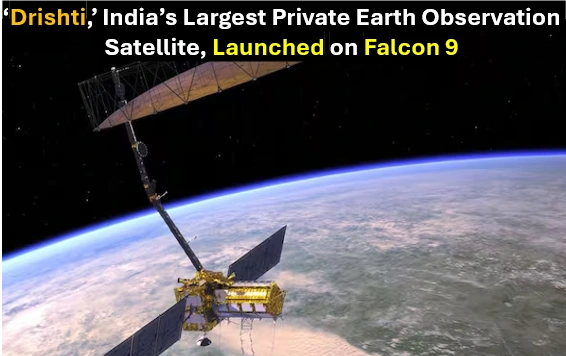

The satellite makes it possible to take pictures of Earth 24 hours a day, in any weather. This is a big step forward in Earth research and shows how India’s space powers are growing.
GalaxEye, a space startup based in Bengaluru, safely launched its first business satellite, Drishti, into orbit on SpaceX’s Falcon 9 rocket. This is a big step forward for India’s private space industry.
As the world’s first “OptoSAR” satellite, the 190 kg spaceship combines electro-optical and synthetic aperture radar (SAR) sensors onto a single platform, which allows images 24 hours a day, seven days a week, in all kinds of weather. The company said the trip was a big step forward in technology for watching the Earth and showed how India’s space skills are growing in the global environment.
Suyash Singh, founder and CEO of GalaxEye, told NDTV before the launch that the project would be a technical breakthrough. He said this to emphasise the need for India to rethink how satellites are built.
He told NDTV, “This mission is called Drishti, which means being able to see through anybody or anything.” It is one of a kind because it has both a multispectral camera and a synthetic aperture radar (SAR) imager built into one base. This is the first method of its kind.
Singh said that India might not have to rely on foreign private satellites as much if it had these kinds of powers. This would let India get high-quality images on its own to measure damage during operations like Operation Sindoor. He also used the current war between Israel, the US, and Iran to show how important it is to have independent space-based observation systems, especially since sharing satellite images is limited.
Imaging in all weather conditions
Drishti’s combination device can take high-resolution visual pictures even in bad weather, clouds, and darkness. It is meant to give more reliable and useful information by joining the two data sets.
The satellite is meant to help with things like monitoring borders, responding to disasters, farming, planning infrastructure, and insurance. Because it has radar, it can keep taking pictures even when there are storms, hurricanes, or a lot of clouds.
Read also: Apple to Introduce Satellite-Based Features for iPhones and Apple Watch
Processing input with AI
An AI system driven by Nvidia’s Jetson Orin platform is one of the most important parts of the ship. This makes it possible to process data in space, which cuts down on the need to send huge amounts of raw data back to Earth and speeds up the release of information that can be used.
GalaxEye said that Drishti can send pictures with a resolution of 1.5 meters and go back to places around the world every seven to ten days. The satellite is about the size of a small refrigerator and has an antenna that can be extended to about three and a half meters.
The company tested its technology in the air with drones, Cessna planes, and high-altitude vehicles on nearly 500 flights. It also flew a payload earlier on an ISRO PSLV mission using the POEM platform.
More and more companies are interested
People in both the private and military fields are already interested in the idea. GalaxEye said it had talks with several government departments and that the Defence Space Agency, the Indian Air Force, the Army, and the Navy have been closely following its progress.
Read also: NASA Launches First Crewed Moon Mission of the 21st Century
Drishti will make it possible for satellites to take pictures in any weather
Suyash Singh, the founder of the company, says that in the past, getting better insights meant mixing data from several satellites. The pictures often didn’t match because they were taken at different times and from different angles. “Drishti” will show you correct pictures of the same place at the same time.
He also said that the company can use AI to turn SAR data into pictures that look like optical images when optical images aren’t available because of bad weather. This means that imaging can be done at any time and in any weather.
India needs Drishti’s science more than anyone else
The main reason this technology wasn’t made sooner is that most satellite companies are based in Western countries, where the weather is usually nice. This method was made because cloud cover is a much bigger problem in India.
Getting optical and SAR technologies to work together was the hardest part of making this satellite. From different points of view, both cameras look at the Earth. Because of this, the company made a system that lets both take pictures of the same place at the same time.

I am a versatile content writer from the MP region, covering politics, business, crime, current affairs, entertainment, video games, and sports with clear insights, engaging analysis, and timely, reader-focused updates.