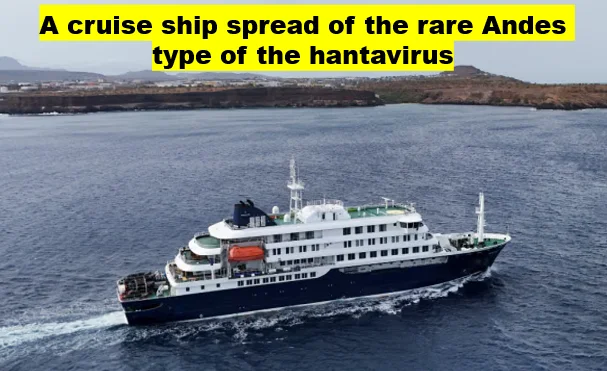

The WHO has proven that the outbreak happened on the MV Hondius. Union health ministry officials say that two Indian citizens are on board the ship and “are presently asymptomatic.”
A tour ship left Argentina early in April and was going to Antarctica. Three people were dead and five were very sick when the ship arrived at its destination off the west coast of Africa last week. They had been infected with Hantavirus, which is one of the strangest and most feared viruses in the world.
At a news meeting on Thursday, Dr. Tedros Adhanom Ghebreyesus, Director-General of the World Health Organization (WHO), said that lab tests have proven five cases and that three more are likely to be cases.
“WHO thinks the risk to public health is low, even though this is a serious incident,” he said.
Maria Van Kerkhove, who runs the WHO’s pandemic and outbreak control unit, told the news gathering. “This isn’t coronavirus; it’s a totally different virus.” Things are not the same as they were six years ago.
WHO confirmed earlier that the hantavirus outbreak
The WHO confirmed earlier that the hantavirus outbreak on the Dutch-flagged adventure cruise ship MV Hondius is tied to the Andes strain. This is a rare strain that is known for being able to spread from person to person.
This strain can take up to eight weeks to show symptoms, so people who have since gone back home to 23 different countries may not be showing any signs yet. So, the WHO said that there might be more cases.
A WHO expert has been sent to the ship. Also, 2,500 testing kits have been sent by the WHO to labs in five different countries.
Scientists, on the other hand, say not to worry.
“Hantavirus usually gets passed from rodents to humans, and it doesn’t work very well between humans,” virologist and study fellow at Oxford University’s Green Templeton College Dr. Shahid Jameel told ThePrint.
What does the Andes strain mean?
The World Health Organization (WHO) says that hantaviruses are a big group of viruses that slowly spread among rodents all over the world. People only get most types when they come into touch with rat urine, droppings, or spit that is affected. This is usually where the infection chain ends. For most members of the hantavirus family, it is not known how they spread from person to person.
The only type that isn’t like this is the Andes breed
The WHO says that when the disease does get passed from person to person, it usually happens after close and long-term touch, usually between family members or sexual partners, and it’s most likely to happen early on in the illness.
The chains are still not very long
This is exactly how the bags on the cruise ship fit. The first two cases were an adult couple who had been to Argentina before getting on the ship. The husband got a fever and a headache on April 6, quickly got worse, and died on the ship on April 11.
His wife got sick after getting off the ship at Saint Helena and died in Johannesburg on April 26. PCR tests later proved that she had hantavirus. A third person was taken from Ascension Island to South Africa for medical reasons and is still in urgent care.
On May 2, a fourth person died. Experts say this is not a case of super-spreaders.
Dr. Jameel said, “If it were a super spreader, you wouldn’t have five or eight cases from a ship with 150 people.”
In 1993, the first known case of hantavirus in the Americas happened in the Four Corners area of the western United States. This is where Nevada, Utah, Colorado, and New Mexico meet.
The study showed that hantaviruses that are spread by rodents may have been spreading in India without people knowing. Scientists identified strains related to Seoul, Thailand and Hantaan viruses, which are associated with haemorrhagic fever and kidney disease in Asia.
Dr. Jameel said that young people who seemed healthy were dying of lung failure that no one could understand. Epidemiological research work showed that it was caused by the Sin Nombre virus, which is spread by deer mice.
“I remember that very well,” Dr. Jameel said. “It was common knowledge among American Indians that when crops were very good, a strange disease would show up and make it hard to breathe.” There were more mice when the crop was good.
There wasn’t much spread from person to person. The Andes virus, which is found in Argentina and Chile, is different because it is the only type of hantavirus that has been shown to be spread between humans.
Read also: Health experts scramble to contain outbreak of deadly nepahvirus
Rarely spreads, but “up to 40% of people who get it die”
There are usually no signs of sickness in the mice that carry the virus. Only a few of the many kinds found around the world are known to affect people.
There are two separate types of hantaviruses that cause very different illnesses. New World strains, which are found in the Americas, affect the cells that line small blood vessels and damage the lungs. This makes the vessels leak fluid, which can lead to breathing failure and, in the worst cases, heart failure.
Dr. Tanu Singhal, an expert in viral diseases at Kokilaben Hospital in Mumbai, said that hantavirus causes a disease called Hantavirus Cardiopulmonary Syndrome (HCPS) in the Americas. Once it starts, HCPS gets worse very quickly.
It starts with a fever, headaches, sore muscles, and feeling sick. After a few days, the patient’s lungs fill with fluid, their blood pressure drops, and they go into shock.
Hantaviruses cause a different condition in Europe and Asia. It is called Haemorrhagic Fever with Renal condition (HFRS), and it affects the kidneys and blood vessels instead of the lungs.

I am a versatile content writer from the MP region, covering politics, business, crime, current affairs, entertainment, video games, and sports with clear insights, engaging analysis, and timely, reader-focused updates.