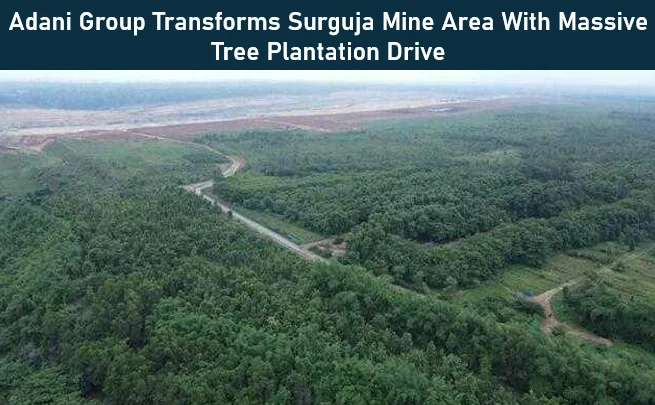

People are talking about a big project in Chhattisgarh’s Surguja district that is restoring the environment and turning a former coal mine area into a lush green scenery. At the Parsa East and Kanta Basan (PEKB) coal mine, Adani Enterprises Ltd (AEL) has planted more than 1.6 million trees and plants over 568 hectares. This shows how mined land can be restored through long-term environmental efforts.
Adani Enterprises was hired by Rajasthan Rajya Vidyut Utpadan Nigam Ltd (RVUNL) to build and run the PEKB mine. People are now pointing out the company’s attempts to restore the land as an example of how to recover land after mining and help ecosystems grow again.
A big plan to plant 4 million trees
The planting of more than 1.6 million trees is a big step forward for the company, but they have even bigger plans for the future. As part of the effort to plant trees, the land will have more than 4 million trees by the end of the decade.
The goal is not only to fix up the areas that were damaged by mine, but also to increase wildlife and make the region’s natural balance stronger. The goal of the project is to improve soil quality and environmental sustainability while also making homes for wildlife.
Government officials working on the project think that large-scale planting drives like this can help fix the environmental problems that mining often causes. The long-term goal is to build an environment that supports local plants and animals and can sustain itself.
Read also: Adani Ports Q4 Results: Net profit improves 10% YoY to Rs 3,329 crore
Reintroduction of native species with a high rate of survival
Reintroducing native tree species that are naturally found in the area has been a key part of the restoration effort. As part of the work to plant trees, a lot of Sal, Mahua, Tendu, Amaltas, and Sidha trees have been put.
The company says that about 88% of these farms are still alive, which is a very good number for a project of this size. Native species’ growth is seen as very important because they are naturally suited to the climate and dirt of the area, which increases their chances of long-term survival.
As part of the program’s strict replacement strategy, 40 trees are planted for every tree that is cut down for mine purposes. This number is a lot higher than the usual requirements for replacement plantations. It is meant to make sure that environmental repair happens faster than the damage that mining activities do to the environment.
One of the project’s most important results has been the successful recovery of Sal trees in the area.
Nursery growth helps with restoration efforts
To keep up with the large-scale planting scheme, the company built a 3.5-hectare farm just for plants. The building is home to about 500,000 seeds right now and is an important part of present and future efforts to plant trees.
The garden helps make sure there is a steady supply of healthy native plants that are needed to heal land that has been mined. The project helps long-term goals for natural recovery by taking care of plants in the area. This keeps the quality of the plantations high.
The project can plant more trees over the next few years because it has access to a big farm. This will help it reach its goal of planting more than 4 million trees.
As environmental experts often say, planting trees is only half the battle; they also need to be cared for during their first few years of growth. The machinery of the nursery makes it possible to reach those goals.
Read also: The Indian Forest Service needs to change
More effects on the environment and community
The effort to fix things up goes beyond the PEKB mine. More than 4,000 hectares of forest land in the forest sections of Surguja, Korea, Balrampur, and Surajpur have been replanted as a form of compensation by the company.
Also, it is said that more than Rs 259 crore has been given to the Chhattisgarh government for planting trees, managing animals, and other environmental protection activities. The goal of these efforts is to help reach larger environmental goals in the area.
The Union Coal Ministry praised the efforts to restore the environment and said that the PEKB mine is a good example of how closing a mine and fixing it up can help make the future better. The minister pointed out that the end of coal mining doesn’t have to mean the end of a mine’s life. Instead, it can be the start of environmental renewal and long-term change.
The bigger program includes more than just environmental projects. It also includes community-based development projects. People who live in and around the mining area can get help with their schooling, health care, and making a living through these programs.
As the planting program grows, the Surguja project is seen more and more as an example of how to balance economic activity with environmental repair. The project has already grown millions of trees and has big goals for the future. It shows that safe farming methods and long-term environmental care are becoming more important.

I am a versatile content writer from the MP region, covering politics, business, crime, current affairs, entertainment, video games, and sports with clear insights, engaging analysis, and timely, reader-focused updates.