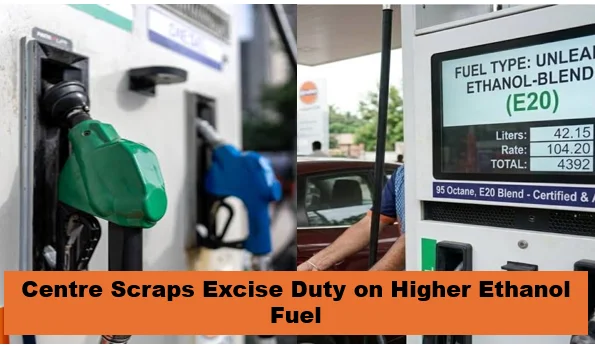

The Union Government has officially scrapped central excise duties on petrol with higher ethanol blending, as part of a significant fiscal measure to speed up India’s transition towards sustainable green mobility. The Ministry of Finance has issued a gazette notification which has reduced the excise duty rate to “Nil” for petrol variants with ethanol content between 22% to 30%.
The measure is meant to significantly cut India’s reliance on imported crude oil and shield the economy from a drastic spike in oil prices in the global market, and also allow India’s agriculture sector to have a profitable domestic market. The government is creating a very inviting economic runway by eliminating heavy fiscal duty on all of the alternative fuels, such as the Basic Excise Duty, Special Additional Excise Duty, Road and Infrastructure Cess, and the Agriculture Infrastructure and Development Cess (AIDC).
The Strategic Shift: the new fuel blends understanding
The aggressive tax exemption is for four new fuel blends that are explicitly defined in the new fuel classification and are well above the E20.The new E20 fuel blend is well below the tax exemption variant this is for and the exempted variants are aggressive blends well above the current E20. The incoming fuels have to meet the strict quality standards outlined by the Bureau of Indian Standards (BIS) in the new standard protocol IS 19850:2026 to avail of the full tax exemption.
The government is intentionally attaching a huge price gap through eliminating the tax burden completely from these higher levels. This will allow these high blend fuels to be gradually introduced from pilot laboratories to retail pumps and will enable them to be offered to consumers at a very competitive discount to conventional petrol.
India’s Energy Horizon: Macro Impact
India is the third largest importing and consuming country of crude oil, importing almost 85% to 90% of its petroleum requirement. This huge dependence consumes foreign exchange and puts the domestic economy in a very precarious situation if there should be any unforeseen geopolitical shock to the supply chain or any global price hike.
This has enabled the country to save a huge amount of capital within its own boundaries by replacing a large proportion of fossil fuel with bio-ethanol produced at home from local agricultural sources like sugarcane, maize, lost food grains etc. and processed here itself to make ethanol. The tax cut is a clear message to the fuel producers and oil marketing companies that the state is prepared to give up immediate taxes to achieve fuel independence in the long term.
Read also: India’s Mobile Networks Face Diesel Crisis as Telecom Towers Struggle to Stay Online
How Does This Affect the Average Consumer?
This policy is a huge step forward for the macro-economy, but, for most people who depend on their car daily, the question is, how is this affecting my commute, immediately?
1. The shrinking number of vehicles at the pump
The short-term goal of the excise waiver is to create a compelling mix at the retail pump. The short-term goal of the excise waiver is to provide a really attractive mix at the retail pump. To put in perspective, the government had recently introduced the high concentration E85 fuel at an incredible price break of about ₹20/litre when compared to regular petrol. Now that the intermediate E22 to E30 blends have been removed from the central excise duty, consumers can be assured of a similar significant reduction in the price per litre when these blends are introduced to commercial fuel outlets.
2. The Rise of Flex-Fuel Vehicles (FFVs)
Ethanol has a lower energy density than pure gasoline and has different chemical properties, so it’s important not to be tempted by pumping E30 or above into a standard older vehicle engine, or risk long-term corrosion and performance problems. Motorists need to move to more modern Flex-Fuel Vehicles (FFVs) to make the most of these tax-free, low-cost fuels. At home, top car makers already have dedicated flex-fuel versions of widely popular commuters that are specially engineered to automatically detect and safely burn any possible blend from E20 to E85.
Read also: Superblu” ethanol flame is cheaper than LPG
Empowering the Rural Economy and Farmers
This tax overhaul is a huge economic booster for the huge agro belt in India apart from the city highways. In effect, the ethanol blending programme is a great way to empower ordinary farmers with the role of fuel suppliers for the country.
With the national ethanol demand increasing from E20 to E30 and beyond, sugarcane and grain farmers have an assured, very robust, secondary income source. Farmers would be able to supply local crops straight to the regional bio-refineries instead of dealing with their devastating surpluses in the local markets and the fluctuating market prices of the food items. This helps to keep cash flowing right within the rural economy, creating local green jobs and timely, reliable grower payments.

I am a versatile content writer from the MP region, covering politics, business, crime, current affairs, entertainment, video games, and sports with clear insights, engaging analysis, and timely, reader-focused updates.