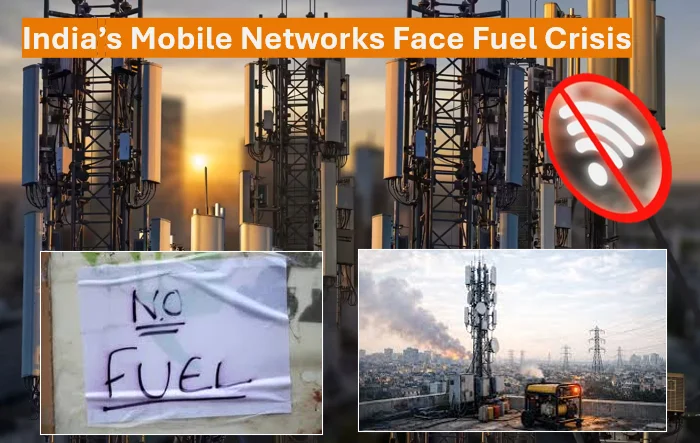

The telecom industry in India is getting worse because gas is running out at cell towers in several states and power isn’t always working. People are worried that the situation will cause problems with the network, especially during the summer months when demand for power is high and blackouts happen more often.
Telecom towers are very important for making sure that cell phone calls, internet access, and digital payments all work well. Even so, many of these towers still rely on gas engines for power when the grid goes down. Experts in the field say that current limits on fuel supplies could make the network less stable if conditions worsen.
At a meeting convened by the Department of Telecommunications (DoT), cellphone carriers, tower companies, and industry groups discussed recent concerns. Reports say that companies raised major concerns about fuel supply in states like Uttar Pradesh, Bihar, Odisha, Andhra Pradesh, and Telangana. Limits on diesel supplies and large fuel deliveries have made it harder for telecom infrastructure providers to run their businesses.
Why diesel is still needed for broadcast towers
India’s power grid has grown over the years, but many cellphone towers still use gas engines as backups. This is especially important in rural and remote places where power outages are common.
When the power goes out, telecom towers move to devices that run on batteries. But these batteries can only keep things running for a certain amount of time. Diesel engines are the only way to keep cell services going when power goes out for several hours.
India is thought to have more than 850,000 cellphone towers spread out across the country, according to figures from the industry. Not all of them are hooked up to a stable power grid. In places where the power grid isn’t very strong, gas is still needed to keep transmission services running.
Experts say the problem gets worse in the summer, when people use a lot more power. Load shedding and long outages put more stress on telecom companies that are already having to deal with rising costs and a lack of fuel.
The price of diesel drives up phone costs
Rising fuel prices are also affecting the telecom business. Due to changes in the global oil market and political unrest, fuel prices have risen sharply in the past few months.
Power and fuel costs make up a big part of telecom running costs, according to figures from the business. Even a small rise in the price of gas can cause telecom companies to spend hundreds of crores more each year.
Analysts say that tower companies are among the hardest hit because they operate large networks of infrastructure sites across India’s cities and rural areas. For service to stay up and running, fuel must always be available, especially in places where the power supply isn’t stable.
Representatives from the industry have warned that if diesel supply problems persist, telecom providers may struggle to keep all their services connected, including 5G and emergency contact systems.
Reports say the Department of Telecommunications told regional officials to work with local agencies to ensure telecom equipment always has access to gas. Groups in the industry are also trying to secure special treatment for telecom services under the category of vital infrastructure.
read also
- Fuel Supply Fears Rise After US Waiver on Russian Oil Ends
- Fuel Shock Hits India Again: Why Petrol and Diesel Prices Keep Rising
- India’s big digital address revolution starts, switch from PIN codes to DIGIPIN
Telecom companies speed up the move to green energy
Because of the current problem, it’s become clear once more how much the telecom industry relies on oil and how quickly better options are needed.
A number of telecom companies have already started using less diesel by investing in systems that run on clean energy. To cut down on fuel costs and dependence, tower owners are using solar powered systems, lithium ion batteries, and mixed energy technologies more and more.
Indus Towers recently added a lot more solar powered towers to its network. At the same time, telecom companies like Bharti Airtel and Vodafone Idea have been working to cut down on gas use by making their power and battery systems better.
Professionals think that switching to green energy is no longer just a good thing for the world, but also a must for business. Solar powered mobile phone towers can help cut down on fuel costs, carbon pollution, and problems that happen over time.
For years, people in the telecom business have been talking about ways to use better energy. Reports from the past also said that diesel engines used by cell phone towers pollute the air a lot. Environmental groups have pushed many times for telecom systems to use more green energy.
Insiders in the business say that switching to green energy options on a big scale will take time and a lot of money. A lot of remote places still don’t have the equipment they need to fully use green energy.
A Very Important Test for India’s Internet Backbone
India’s digital economy relies on cellphone connections that don’t drop out. Millions of people can’t live without their mobile networks. They use them for everything from online banking and UPI transfers to working from home, watching videos, and calling for help in an emergency.
Any big problem with telecom could have an impact on companies, digital services, and daily contact all over the country. As 5G continues to grow quickly, it’s become even more important that networks work well.

I am a versatile content writer from the MP region, covering politics, business, crime, current affairs, entertainment, video games, and sports with clear insights, engaging analysis, and timely, reader-focused updates.