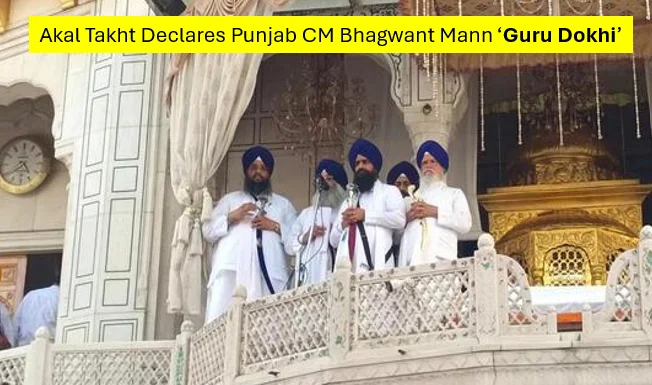

The Akal Takht, which is the highest temporal seat of Sikh power, has named Punjab Chief Minister Bhagwant Mann as Guru Dokhi because of some things he is said to have done and said. The choice has sparked considerable debate in Punjab’s religious and political circles, since the Sikh community places great weight on what the school says.
The statement came from the Sikh high priests, who were very angry about things they saw as going against Sikh customs and beliefs. The action is a strong religious rebuke that has brought new attention to the connection between the Punjab government and Sikh religious groups.
Concerns were raised about a video that went viral and other public comments by the Chief Minister, which led to the decision. The problem is said to have been talked over by Sikh leaders before the final decision was made.
Arguments over a video that went viral and some statements
A video about Bhagwant Mann went viral, prompting Sikh leaders to respond. This led to the debate involving him. Reports say that Sikh top priests looked into the case and decided that the content and comments about it were offensive to religious feelings.
The Akal Takht made its choice after people talked about whether the Chief Minister’s acts showed disrespect for Sikh beliefs. Within Sikh faith practice, the statement of “Guru Dokhi” is seen as a strong way to show disagreement.
People are also wondering what public people should do when they deal with religion problems because of this. People pay close attention to what leaders and organisations say about faith, society, and community ideals.
In Punjab, where religious identity and political authority often intersect, the dispute has now become a major issue.
The latest development comes after the Akal Takht gave the Punjab government a strict 15-day deadline to remove what it called objectionable clauses from the legislation. People who are familiar with the situation were expecting an order against the newly passed law.
The anti sacrilege Bill, which suggested changes to the 2008 Act, was passed by the Punjab Vidhan Sabha unanimously on April 13. The sitting was a special one-day event. The Bill was signed into law by Governor Gulab Chand Kataria of Punjab on April 17. It was then made public by the Punjab government on April 20.
The Act has harsh punishments for acts of sacrilege against the Guru Granth Sahib, such as life in jail and fines of up to ₹25 lakh. However, the way it is run has caused a religious debate.
On May 8, the disagreement turned official when the Akal Takht officially rejected the new anti-sacrilege law. Speaker Kultar Singh Sandhwan had gone before the group to explain the government’s stance. After that, the Takht gave the state government 15 days to get rid of the specific parts that it said “hurt Sikh sentiments and interfered in Panthic affairs.”
The Akal Takht sent a follow-up letter to the Speaker on May 11 outlining its main concerns. It mainly pointed out parts of the bill that require the Shiromani Gurdwara Parbandhak Committee (SGPC) to keep a digital record of all saroops scriptures. This places the Guru Granth Sahib, Sikh institutions, granthis, pathis, gurdwara committees, and sewadars under state law.
Even though there was religious pressure and his lawmakers were going to be called in on June 29, Chief Minister Mann stood firm on the law and said it would not be changed or weakened.
read also
- CM Dhami finalises strict action plan for Char Dham Yatra 2026
- Candidate’s Kalava thread cut during UP police exam
Effects on politics after Akal Takht’s choice
It is likely that the statement made against Bhagwant Mann will also have strategic effects. The Chief Minister is a constitutionally important figure, and any disagreement involving a major faith group can affect public sentiment.
The problem has made things difficult for the Punjab government, and people are still debating how to balance political power with religious sensitivities.
Bhagwant Mann has been questioned in the past about what he said and did about Sikh institutions. Earlier, he had gone to the Akal Takht after being asked to, following claims that he had said things about Sikh customs that were seen as wrong.
The new statement has made the argument stronger, and it may stay a big issue in Punjab’s politics for a while longer.
Reactions and What Will Happen Next
Since the news came out, everyone is now looking forward to seeing how Bhagwant Mann and his government react. Because of the statement, people are talking about politics and religion at the same time.
People who support and criticise the Chief Minister have had different reactions, and the issue is now being talked about in public. Some people think the choice was needed to protect religious values, while others are looking at what it means for politics in a broader sense.
As different groups react to the Akal Takht’s ruling over the next few days, further changes are likely. This problem has once again shown how important Sikh faith organisations are to the social and political life of Punjab.

I am a versatile content writer from the MP region, covering politics, business, crime, current affairs, entertainment, video games, and sports with clear insights, engaging analysis, and timely, reader-focused updates.