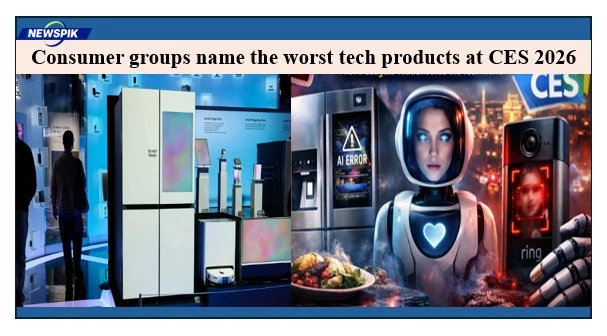

In the neon-covered corridors of the Las Vegas Convention Center, CES 2026 was intended to be the year AI disappeared behind our lives—a well-oiled, invisible layer integrated to help us live. For all those consumer advocacy groups, though, the year was “AI-everything” gone haywire.
As the show winds to a close, a group of privacy experts, right-to-repair advocates and sustainability groups put out their annual “Worst in Show” list. From handle-less voice-activated fridges to lollipops that play music through your skull, the winners of 2026 showcase a tension that’s been brewing for years: Tech firms are so eager to “AI-ify” their wares, they’re breaking some key things we throw money at.
The Over-Cooler King: Samsung’s Handleless Fridge
Taking the top spot as the Overall Worst in Show is the Samsung Bespoke AI Family Hub refrigerator. In a maneuver that seemed to leave judges scratching their heads, Samsung simply did away with physical handles altogether, opting instead for a motorized solution that opens the door through voice command or via “trigger word,” such as … yes, you guessed it: “Open Sesame.”
“The one thing a refrigerator is supposed to do — and I hope we can all agree on this —is keep stuff cold,” said Gay Gordon-Byrne of the Digital Right to Repair Coalition. “ In floor demos, the fridge notoriously failed to pick up commands over the ambient din of all those people—a struggle critics say will be reflected in a loud, clattering family kitchen.
Five Bold Tech Predictions for 2026- Why Wall Street May Be Underestimating AI Growth
Privacy Red Flags: Amazon Ring and AI ‘Soulmates’
The Electronic Frontier Foundation (EFF), privacy advocates, went after Amazon’s Ring Security System. Among the 2026 upgrades are “AI Unusual Event Alerts,” which use facial recognition and behavioral analytics to identify everything from “undeliverable delivery people” to “wandering wildlife.”
Nothing could be worse for our law enforcement and intelligence operations than to think that there’s no limit on the information that they can compel private companies — and the public — to cough up, simply because terrorism is scary. “This doubles down on the mistaken belief that more surveillance equals more security,” wrote at least two of the judges. They were especially worried about a new app store for the doorbell that enables third-party developers to design even creepier forms of tracking.
A close runner-up was Lepro Ami AI “Soulmate,” which took home the People’s Choice in worst product. Marketed as an “always-on 3D companion” for isolated remote workers, the device features eye-tracking and voice-tone analysis to create “empathetic” interactions. “All of us felt weird about it),” one of the advocates said, noting that they found “uncomfortable” Reddy’s presumption that a home office should have a device staring into its user’s face all day.
Google confirms that the first AI smart glasses will come out in 2026
Environmental Sin: The Musical Lollipop
In a questionable category that confused some, the Lollipop Star won for Worst Environmental Impact. The device plays music through your jaw via bone-conduction technology as you eat the candy.
The tech is cool. The cost to the environment, not so much. The product is entirely disposable; after the candy has been eaten there is practically nothing left, just the battery and circuitry to throw away. It wasn’t quite a hit, as iFixit CEO Kyle Wiens dubbed it “literal garbage you can taste” while unleashing on the trend of throwing some unrecyclable electronics into easily disposable consumer goods.
The “Enshittification” Award: Bosch e-Bikes
This year, the tech critic Cory Doctorow gave out a special award for “Enshittification”—described as what happens when useful tech gets worse because money-making features are added to it. The recipient was Bosch, for its new e-bike “parts-pairing” software.
The system relies on AI to determine whether a replacement part (like a motor or battery) is from a third party. The bike’s software is programmed to “lock” the motor if it is not a part approved by Bosch. Judges said this was a substantial limitation on the options for consumers to repair their own vehicle and converted a durable good into what effectively was a proprietary “subscription” on wheels.
AI Without Internet Could Soon Make Smartphones Smarter, Says Austin Scientist
Conclusion: The “AI Slop” Era
The 2026 “Worst in Show” competition provides much-needed sobriety for an industry that is, right now, as high on AI hype as it’s ever been. There were real innovations revealed at CES, such as noninvasive glucose monitors and smarter energy grids, but those often got obscured by the “AI slop.”
When companies place fancy “smart” features above durability, privacy and core functionality, consumers lose. As we push forward into 2026, advocacy groups have a message for companies: If a product requires a Large Language Model to even make a cup of coffee or open a door, well then it may not be “intelligent”— it may just be catastrophic in the making.

I am a versatile content writer from the MP region, covering politics, business, crime, current affairs, entertainment, video games, and sports with clear insights, engaging analysis, and timely, reader-focused updates.









