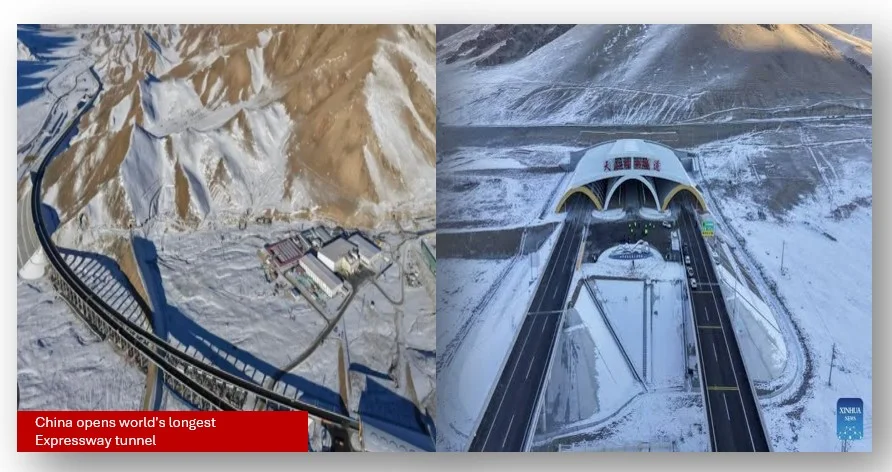

China has opened the world’s longest expressway tunnel, the Tianshan Shengli Tunnel, which is 22.13 kilometers long, situated in the Xinjiang Uygur Autonomous Region, symbolizing an important achievement in global infrastructure building, especially for the transport network covering the Tianshan Mountains.
Tunnel, which is part of the G0711 Urumqi-Yuli Expressway, was opened on December 26, 2025, and is now operational, reducing what was a several-hour drive to just 20 minutes.
Historical Geographic Barrier Overcome
The Tian Shan Mountains, or the “Celestial Mountains,” stretch over 2,500 kilometers in Central Asia and have historically served as a geographical divide between northern and southern parts of Xinjiang. Before the construction of the tunnel, travel times in the region were sluggish and dangerous, particularly during the winter seasons when snow and icing made travel particularly perilous.
Opening of the tunnel replaces a road journey route that was slower and more hazardous compared to the current route facilitated by this tunnel that enables faster movement through the mountains without posing any dangers to users.
Cabinet approves 3 new corridors under Delhi Metro’s Phase 5 (A) Project
Engineering Marvel and Global Record
With a length of 22.13 km (or approximately 13.75 miles), the Tianshan Shengli Tunnel has currently earned the record for being the longest expressway tunnel in the world. It has broken records in the field of road construction.
As claimed by project officials, this project also created history by holding the world record in the vertical shaft of a highway tunnel, giving this project two world records in expressway projects.
Construction started in April 2020 and took almost five years. The project engineers and laborers overcame many challenges: complex geology, subzero temperatures, high elevations, and seismic movements. The tunnel passes through 16 geological fault areas and reaches depths of over 1,100 meters beneath the mountain ridge in certain parts.
According to experts, the project represents a technological leap forward in the fields of tunneling, design, construction methods, as well as intelligent transportation systems.
Chinese Train Breaks World Speed Record Reaches 700 km/h in Just Two Seconds
Regional Connectivity and Economy Boost
The expressway and the tunnel greatly enhance connectivity between Urumqi, the regional capital in northern Xinjiang, and Korla, a big city in the southern part of the province. Estimated by relevant sources, travel time between Korla and Urumqi has been reduced to three and a half hours, as opposed to previous travel times of roughly seven hours. This is for a complete route along the expressway.
Removing obstacles to mobility, it is anticipated that this tunnel will speed up economic integration, not only between Xinjiang, China, but in other regions. The new expressway is connected to other major transport arteries, such as expressways that connect Xinjiang to eastern China, as well as transcontinental trade routes to Europe, through Central Asia.
Officials and experts have stated that this upgraded transportation connectivity will be beneficial for all local industries, the tourism sector, logistics, and trade, which will result in this location becoming more attractive for investments and developments. This upgraded connectivity will further help Xinjiang act as a crucial point for the China-Central Asia-West Asia Economic Corridor, a part of the Belt & Road Initiative.
Safety and Technological Integration
Besides its massive engineering design, it also utilizes sophisticated safety measures and monitoring systems that promote a seamless operation environment, even for such a geologically complex site as found in China. These are real-time risk monitoring systems and automatic traffic management systems to enable high safety levels throughout the tunnel.
A Symbol of China’s Infrastructure Aspirations
The opening has been widely welcomed as a symbol of Chinese engineering capability as well as a functional achievement that provides concrete benefits to millions of passengers and freight carriers as well as Xinjiang citizens. With continued investment by China in transport infrastructure, ranging from roads and high-speed rail to large-scale tunnels such as Tianshan Shengli, this particular construction project is an indication of China’s long-term vision to connect its large geographical mass to international markets.

I am a versatile content writer from the MP region, covering politics, business, crime, current affairs, entertainment, video games, and sports with clear insights, engaging analysis, and timely, reader-focused updates.