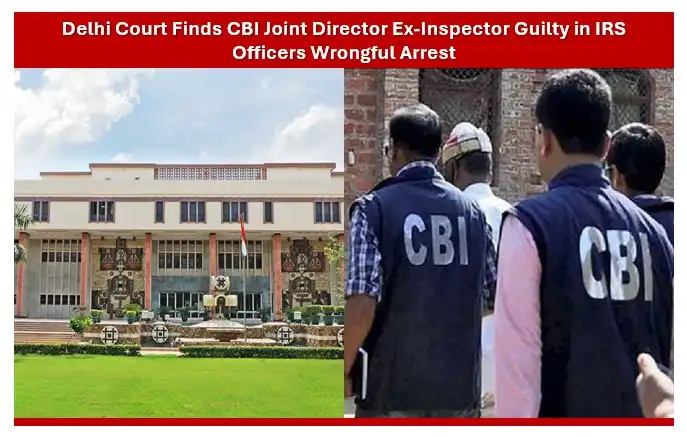

Among the defendants were a recipient of the President’s Police Medal, now working for the CBI, and a retired officer. The court said they abused their authority when they raided and arrested the accuser, Ashok Kumar Aggarwal.
On Saturday, a court in this city found two Central Bureau of Investigation (CBI) officers guilty of assault, criminal trespass, and damage. The court said that their raid and arrest of an Indian Revenue Service (IRS) officer in 2000 was not part of their official tasks.
From 1996 to 1998, the IRS worker served as head of the Enforcement Directorate (ED)
The court said that the CBI officer did what they did with the real goal of overturning an order from the Central Administrative Tribunal (CAT) that favoured the IRS officer.
The officers who were found guilty are Ramneesh Geer, who is currently a Joint Director at the CBI and was a Deputy Superintendent of Police at the time of the event, and V.K. Pandey, who is retired and was an Inspector at the CBI and an Assistant Commissioner of Police.
Geer has been a member of the CBI’s in house staff since 1994 and was given the President’s Police Medal for Distinguished Service in 2022.
This case is being brought by Ashok Kumar Aggarwal, an IRS officer from the 1985 batch. He was being sent to the Delhi zone to work as a Deputy Director of Enforcement when he was caught.
also read: Chhattisgarh Vedanta power plant blast
Magistrate Shashank Nandan Bhatt made the decision in the case
Magistrate Shashank Nandan Bhatt made the decision in the case that Aggarwal filed in October 2001. He said that a raiding team of the CBI led by Geer and including Pandey broke into his home early on October 19, 2000, and dragged him down the stairs before capturing him. This was considered criminal trespass.
Based on the complaint, the magistrates who came before him had called Geer and Pandey in January 2005 as there seemed to be a strong case against them under Sections 323/427/448/34 of the old Indian Penal Code. These sections dealt with crimes like causing harm on purpose, mischief, causing damage, breaking into someone’s home, and common intention.
The charges were made by the court in August 2017, which is why the two are now being found guilty. There will be a sentence on April 27.
Based on a careful analysis of the facts and evidence in this case, the court believes that the accused persons’ search and arrest on October 19, 2000, were clearly beyond their legal authority and were only done to frustrate and overturn the order from September 28, 2000, issued by CAT, which called for the review of the complainant’s deemed suspension within four weeks. This was done solely to overturn the order.
also read: Gurugram Noida and Ghaziabad RWAs clash
What took place 26 years ago
The case goes back to 1999, when someone, Aggarwal, was looking into the Foreign Exchange Regulation Act (FERA), 1973, and “falsely implicated in active connivance with the officials of the CBI.” This is what the Saturday order says.
Aggarwal said that his boss, who was Director at the time, tried many times to stop the investigation into several cases involving lawmakers and businesses that he was in charge of.
In his court charge, Aggarwal said that in March 1999, a group led by Geer broke into his home after the CBI filed a criminal case against him. As they searched, the agency took several papers that had to do with his and his family’s tax returns.
After the papers were taken, he was charged with having too many assets in December 1999. Aggarwal said Pandey called him more than 20 times about the situation.
Aggarwal was suspended by the Ministry of Finance
He fought this decision in court, and in September 2000, the CAT told the ministry to review the “deemed suspension” within four weeks.
The court order says that soon after Aggarwal got a good decision from the CAT, he “heard accused no. 2 (Geer) speaking to officials of the Ministry of Finance to delay the review of suspension” and that Geer “would be further implicated in other cases.”
Aggarwal thought the CBI officials working on his case might do something like this, so he sent a letter to the Revenue Secretary at the time. The Revenue Secretary then asked the CBI to take a stand on the issue by October 18, 2000.
Judicial Magistrate Bhatt pointed out that the office of the Superintendent of Police (CBI), which was supposed to give the reply by October 18, 2000, held a meeting in the evening of that day and decided to search and arrest the complainant the next morning, even though the complainant had already met with the investigating officer 21 times for an investigation.
If you look at all of these things, it’s clear that what the accused people did on October 19, 2000, was done on purpose to overturn the order from September 28, 2000, which said that the complainant’s deemed suspension had to be reviewed within four weeks. This means the accused used their power improperly.

A versatile writer mainly works on trending news, daily updates from politics, business, crime, current affairs and entertainment.