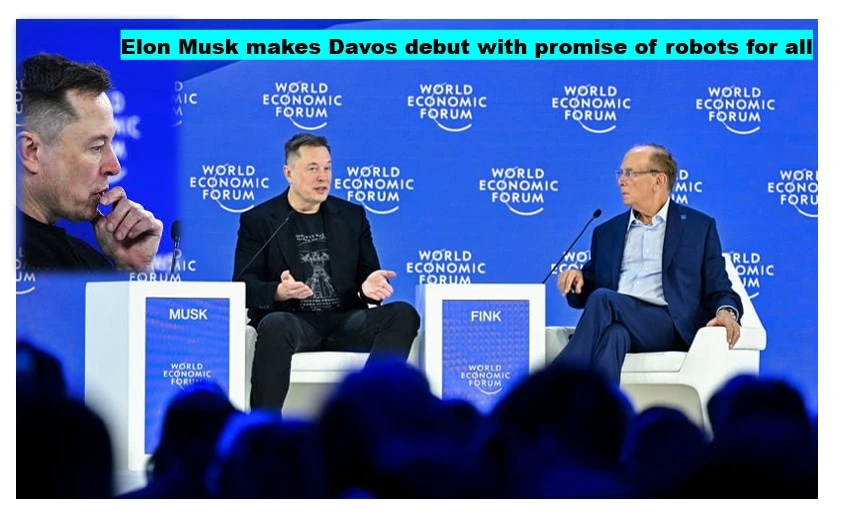

The relationship between Elon Musk and the World Economic Forum (WEF) has been known in recent years for digital grenades launched from across an ocean. Musk, who famously derided the annual gathering in the Swiss Alps as “boring AF,” also said he wondered if a shadowy group seeking to create an “unelected world government” was going after being “boss of Earth.”
But on Thursday, January 22, 2026, the story took an unexpected twist. Then, in a last-minute ad hoc insert that caused shockwaves across the Congress Centre, the world’s richest man made his Davos stage debut. Emerging a day after his political ally, President Donald Trump, spoke at the same conference, Musk jumped into a straight-talking one-on-one with BlackRock CEO Larry Fink.
What ensued was not the hostile takeover that some critics had feared but a freewheeling, at times humorous and deeply visionary discussion about everything from whether consciousness will survive to the eventual ascension of our future robot neighbors.
‘Boring’ to Bold: The Unexpected Entrance
The question on everyone’s lips: Why the change of heart? For years Musk has been the ultimate outsider, deriding the “global elite” — all while running companies that dominate global discourse and infrastructure.
Insiders say his presence indicates a “pragmatic recalibration.” As Musk’s own influence has come into sharper focus (he’s certainly got a lot of it), and following his recent stint working for the Trump administration improving government efficiency, and given that he still has huge stakes in both AI and space, Davos was an opportunity which could not be missed.
“Abundance for All”: The False Promise of the Robot
The focal point of Musk’s speech was a motivating idea that he came back to time and time again: Abundance. In Musk’s world, this is necessary because he believes that only superintelligent AI and humanoid robots are realistic solutions to eliminating global poverty and improving quality of life everywhere.
He brought a level of specificity to the timetable for Tesla’s Optimus humanoid robot that shocked even experienced analysts:
- Industrial Complexity: Musk said Optimus robots are already doing easy jobs in Tesla factories and will be handling “complex industrial tasks” by the end of 2026.
- Public Sales: In a bold account, he claimed that Tesla will be selling walking robots to the public as soon as 2027.
- Ubiquity: Musk also posited that eventually robots will outnumber humans—maybe even two to one.
“Who doesn’t want a robot to look after your kids, take care of your pet or protect and care for an aging parent?” Musk asked. He posited that when labor is effectively “free” using robots, the global economy will have no historical equivalent of such an explosion.
As Fink turned the conversation to SpaceX and the future of humanity, Musk shifted his talking points from economics to philosophy. He returned to his long-held vision of Martian colonization, though with a more muted emphasis on the “fragility of consciousness.”
No, his appeal to make life multi-planetary, he said, isn’t about fleeing Earth, but rather creating “consciousness redundancy.” He made light of his own destiny saying, “I want to die on Mars — just not on impact,” a line that has become a standard part of his public presentations but felt more poignant in the high-stakes environs of Davos.
The ‘Peace or Piece’ Dig: Maneuvering Geopolitics
Despite Musk being one of President Trump’s most ardent supporters, he couldn’t resist taking a shot at the current round of headlines surrounding the administration. Earlier in the week at Davos Trump announced a “Board of Peace” to mediate global conflicts and reopened the debate about America’s potential role in Greenland.
Musk quipped that the board should have been called “Piece” instead of “Peace.” “I thought, is that P-I-E-C-E? You know, a little piece of Greenland, a little piece of Venezuela — all we want is a little bit,” he said with an impish shrug, eliciting both gasps and laughter from the audience.
Though Musk joked, he did signal a policy difference with the administration on energy. While Trump has championed oil and gas, Musk used the Davos stage to promote solar. He declared that a tiny corner of Utah or Nevada could meet 100 percent of the nation’s energy needs, if only tariffs on solar modules “were removed.”
The Electricity Bottleneck
The most practical piece of Musk’s talk was likely on the coming “electricity crisis.” He cautioned that what was holding back AI development was no longer chips or models, but the power grid.
“Pretty soon there will not be any chips to play,” and “not even electricity things” he cautioned, otherwise Musk assumes the morning airports don’t pay for their juice. “The only problem is that the power grid’s growing at 3-4% a year, but AI training demand is increasing by 10x,” he said. His answer would be enormous solar infrastructure on the ground and even space-based AI data centers sent up by SpaceX to get unlimited sun and naturally cooling orbiting in space.
Conclusion: An Optimist’s Caveat
Elon Musk finished his surprise Davos debut with a message of cautious optimism. While noting the dangers of AI — with a reprise of James Cameron’s Terminator used as a cautionary bedtime story — he was in town to encourage positive thinking: This stuff is awesome.
“What’s interesting is it’s so much better for your quality of life to err on the side of being an optimist and be wrong, than to be a pessimist and be right,” he finished.
When he stepped off the stage, the atmosphere here in Davos felt fundamentally transformed. The man who had once scorned the forum as “irrelevant” was suddenly its most-discussed participant. And whether it’s a real “thaw” in his to-date icy relationship with the global establishment or just the most recent stepping stone of his growing influence, one thing is for sure: the age of “robots for all” now has a new, big public roadmap.
Elon Musk Dances with Tesla’s Humanoid Robot Optimus in AI-Generated Video

A versatile writer mainly works on trending news, daily updates from politics, business, crime, current affairs and entertainment.









