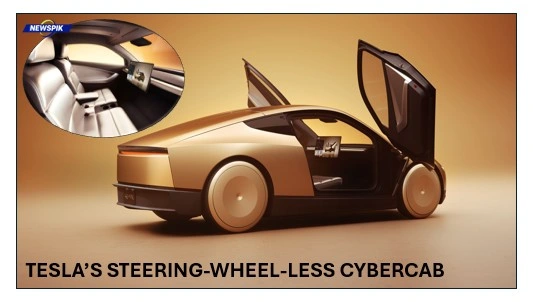

The first unit of Tesla’s much talked about Cybercab has rolled off the assembly line. This is a big step forward for the company in its quest for a future with fully driverless vehicles. The fact that the car was built without a steering wheel or pedals represents a significant shift in how things are designed, even though full self-driving capability is still not a reality.
The company that makes electric cars is stepping up its efforts to deploy AI and robot taxis as it builds the first Cybercab unit. But people in the business say that governmental approvals and technology problems with autonomous vehicles are still going on.
First Steering Wheel Less Unit Leaves Production Line
The brand new Cybercab stands out because it doesn’t have any standard driving buttons. In contrast to regular Tesla cars, which still have driving wheels and pedals, this type is specifically made to drive itself.
Reports and pictures show a simple interior that is all about making passengers comfortable. The car looks more like a small living room than a place where the driver can work. This way of designing cars is in line with Tesla’s long term goal of making cars that can drive themselves.
Even though the first unit’s release shows that the company is ready to start making them, they haven’t said when the public launch will happen yet.
Autonomy Still Under Development
Even though Tesla has reached a production milestone, fully automated driving without a driver is still a ways off. The Cybercab was made with the idea that one day, advanced AI systems will do all the driving. However, this feature is still being tested and reviewed by regulators.
People have questioned Tesla’s driving help system in the past about what it is called and how well it works in real life. Regulators in a number of areas are still reviewing safety statistics for fully and partially driverless features.
There is a lot of discussion in the car industry about a vehicle that doesn’t have a steering wheel that is already in early production before it gets full autonomous approval. Analysts say that the car can’t be properly driven on public roads in most areas until it has been approved to fully self driving.
Regulatory and Safety Challenges Ahead
There are a lot of legal and safety issues that need to be cleared before a car without human controls can be used. Most of the time, transportation officials need a way for people to get involved if automatic systems fail. Taking away the driving wheels and pedals takes away that backup choice.
Experts say that showing that a fully driverless system is safe will take a lot of tests on the road, clear data reporting, and working with authorities. Any accident involving this kind of car could have a big effect on people’s trust.
Safety advocates stress that while technology could finally cut down on crashes caused by human mistake, putting it into use too soon without fully testing it could be dangerous.
Elon Musk Dances with Tesla’s Humanoid Robot Optimus in AI-Generated
Strategic Shift Toward Robotaxi Vision
The Cybercab fits in with Tesla’s larger plan to create a base just for robot taxis. The company doesn’t seem to be adopting current car types; instead, it seems to be building cars from scratch for use in a driverless service.
If they work, these kinds of cars could help ride hailing services run without human drivers, which could lower costs and change how people get around cities. The idea also helps Tesla’s push toward software driven income, which is based on the idea that self driving cars are key to its business plan.
Analysts in the field say that making a prototype without a turning wheel shows faith in long term technological progress, even if short term legal clearance is still uncertain.
Business Watches Next Steps
Competitors and government officials are keeping a close eye on what Tesla does next. Many tech and auto companies are investing heavily in self driving car research, but most of their test vehicles still have human controls.
The release of the first Cybercab does not mean that they will be used right away, but it does show that Tesla wants to be the leader in the transition to driverless transport. In the next few months, software evaluation, safety demos, and working with regulatory bodies are likely to be the main topics.
For now, the Cybercab is both an important step forward in engineering and a warning of how much work still needs to be done before fully driverless cars without turning wheels are popular on public roads.

A versatile writer mainly works on trending news, daily updates from politics, business, crime, current affairs and entertainment.









