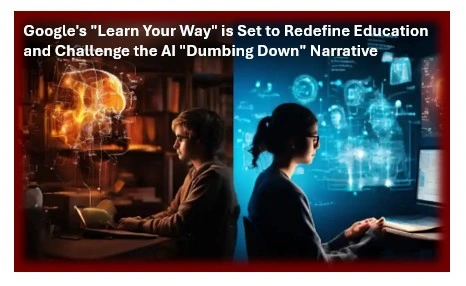

A steady hum of anxiety about the role that automation and artificial intelligence will play in the future of work began to percolate, and not just from Silicon Valley. The narrative that tech’s never-ending quest to artificially improve upon human knowledge and tradition is “dumbing us down” fits into this: That the brain is a trampoline, and that with AI doing most of the heavy lifting — writing, summarizing reality, solving issues — human thinking will atrophy. Critics foresee a future of “passive learners” who are outsourcing their thinking to a black box, trading deep understanding for the ease of an immediate answer.
But “Learn Your Way,” a new Google program, is turning that script on its head. Launched as a research-driven experiment, its goal isn’t just to give us answers, but the very architecture of how we consume knowledge. Google, by changing point-and-click textbooks from static one-size-fits-all experiences into dynamic and multimodal hyper-personalized ones, is making the case for AI that, when based in pedagogical science, can make us sharper not slower.
From Dead Pages to Living Knowledge
The conventional textbook did not evolve in hundreds of years. Whether it’s a cumbersome hardcover or a flat PDF, the content is static — written for an “average” student who does not exist. When the language is too dense or the examples are unrelatable, the student just tunes out. This is when “dumbing down” often kicks in: in the clash between an antsy mind and an inflexible medium.
“Learn Your Way” breaks down that wall. Leveraging Google’s custom learnLM model—a suite of AI models specifically adapted for the educational context—the tool lets students upload a textbook and, with the touch of a button, automatically “re-level” its content.
The Punch of Personalization: Interests as a Magnet
One of most humanizing features of “Learn Your Way” is the faculty to connect what a student is passionate about into curricular offerings. We also know that the brain tends to learn new information more readily when it can hook a new concept onto something familiar.
In the “Learn Your Way” interface, students can choose interests including sports, cooking and music. The AI simulates and adjusts the teaching analogies on-the-fly.
The Physics of Motion: A student who enjoys basketball could discover how projectile motion is represented in a three-pointer.
Economics: A music enthusiast might study economics through the prism of concert ticket pricing and the production of vinyl.
This isn’t just a “gimmick.” It is the practical use of Dual Coding Theory, which states that verbal and visual information in human minds are stored separately. Through offering several modes of delivery, (audio lessons, interactive mind map and narrated slides), it makes sure that the learning “struggle” is a constructive one rather than a frustrating exercise.
The Teacher’s Role in an AI World
There is a frequently held fallacy that tools such as “Learn Your Way” are looking to do away with the teacher. In fact, they are supposed to address what’s known as the “two sigma problem”—the education theorist Benjamin Bloom found that students who were tutored one to one did two standard deviations better than their peers in a traditional classroom. Since one teacher can’t be 30 tutors at the same time, AI steps into that breach.
The Future: Friend or Foe to Lifelong Learning?
“Learn Your Way” is in an experimental stage right now in Google Labs, but is a game changer. We are entering an era in which “learning” no longer has a set location that exists between 8:00 AM–3:00 PM.
Think of a professional in 2026 who needs to learn a new programming language, or a medical researcher that wants to catch up on a different field. “Rather than trudging their way through dense journals, they would be able to use this device to set up whatever custom ‘on-ramp’ works for them” — perhaps converting a complex PDF into a series of audio lessons that they could work though on their commute, or making an infographic visualizing the connections between new data points.
By elevating agency, curiosity and understanding over distractions, Google is demonstrating that A.I. doesn’t automatically have to be the shortcut to the answer. And it can also be a better way to travel the path.

I am a versatile content writer from the MP region, covering politics, business, crime, current affairs, entertainment, video games, and sports with clear insights, engaging analysis, and timely, reader-focused updates.