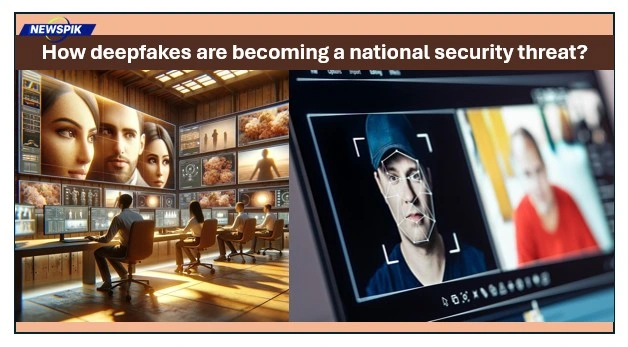

Deepfake technology, or AI-driven audio and video recordings that can imitate real people, has grown in sophistication in recent years. What was considered research several years ago is now available to anyone who owns a computer and an internet connection. With its growing sophistication, it is becoming a danger to national security and public trust.
1. What are Deepfakes?
“Deepfakes” are artificially generated images or videos produced using artificial intelligence algorithms known as deep learning. These algorithms are trained on data sets containing images or audio or video recordings of a particular individual to generate very realistic images or videos of them speaking, or doing things they have never done before. Today’s generative algorithms are capable of producing “deepfakes” that are very hard to tell from the actual video.
While there are legitimate purposes (entertainment and assistive uses), security communities and countries globally expressed concerns about its potential for malignant use.
2. Chattels / Private Property – Intangible Chattels
One of the primary national security challenges presented by deepfakes is the degradation of credibility in authoritative information. Deepfake misinformation could be used to:
- Produce false quotes from political leaders regarding issues with high sensitivity,
- Misreport incidents in war zones
- Create speeches that shape public opinion
If the information gets shared very rapidly on social sites, it gets difficult for the citizens to identify what is going on in the world and what is mere information generation—the “information apocalypse.”
This can make societies more susceptible to tampering with the process and the elections themselves; also lead to a lack of confidence in the electoral and democratic process; and even serve as cover for malicious parties to shape the story in the case of a geopolitical incident.
3. Disinformation in Elections and Political Crises
Deepfakes could be used for spreading misleading information that could shape nationalist politics. Ranging from faked audio of a nationalist politics leader trying to demote voters to videos of a candidate who has different views on matters of state.
The effect is that such information can spread rapidly, and efforts at fact-checking will not keep pace; this diminishes confidence in the results of an election. Once a deepfake is circulating, it may stay online forever and continue to erode confidence well after it has been disproven.
Political deepfakes also feed into what is called the liar’s dividend, in which actual evidence can be dismissed as “fake” by the guilty looking to escape punishment.
These effects can lead to the erosion of democratic institutions and make societies more vulnerable to foreign influence operations.
4. Threats towards Military and Diplomatic Stability
Deepfakes can also be used in geopolitical crises as a means to produce fake signals of intent from states or their military leadership. Examples of fabricated military orders, announcements of a ceasefire, or misinformation regarding troop movement provide just a few instances in which a fabricated recording may bring a conflict to an end too soon or otherwise mislead decision-makers.
Deepfakes could be used by hostile states or proxies to influence diplomatic relations, provoke mismatches in interpretation of events, or raise tensions in fragile regions.
5. Cyber-Attacks and Critical Infrastructures
Apart from information warfare, deepfakes are also connected to cybersecurity threats. Scammers and hackers can make use of deepfakes in voice or video calls to masquerade as major personalities in government institutions or in critical infrastructure industries. Such deepfakes could be utilized for:
- Trick employees to give up confidential information,
- Bypass authentication mechanisms using either voice or facial recognition,
- To commit frauds/illegal transactions.
These breaches could cause problems for national security agencies in terms of compromised classified information, response capability, and/or secure access systems.
6. Economic and Corporate Espionage Impacts
“Deep Fakes” are also a danger to the national economic security of any country in matters relating to corporate fraud and espionage. A deep fake audio or video recording of company executives can convince an employee to initiate large, fraudulent wire transfers, as there are already actual occurrences that have been documented, or to release trade secrets.
Nations require strong economic institutions. In case deepfakes create instability in confidence levels regarding market, financial, or governance institutions, the economy as a whole may be impacted.
7. Legal, Ethical, and Policy Challenges
Removal of deepfake dangers involves many cultural and moral complexities. Nations are focusing on legislation to make platforms or producers liable for deceptive content. In this case, the TAKE IT DOWN Act in the USA stipulates that platforms should delete non-consensual deepfakes within a given timeframe upon receiving notification.
However, creating laws that address both freedom of speech and security is not an easy task. Errors can result in an overreach of power and the censorship of legitimate content. This is because the pace at which AI advances far outstrips the ability of regulators, who are forced to try and keep up with the AI they are attempting to regulate.
8. Detection and Defense: An Ever-Escalating Arms Race
“Protecting oneself against deep fakes is itself an issue of national security. Methods of detection are constantly being developed and are based upon algorithms to recognize tampering in real-time. Watermarking is also being used to track the origin of genuine footage.”
However, with the advancement of detection, there is an escalation in the quality of deep fakes. This is a challenge for security on a national and international level.
Microsoft AI Chief Issues Warning- You Can’t Control What You Don’t Contain
Conclusion
Deepfakes have grown from a novelty into a complex threat to national security. Deepfakes are used as tools in misinformation operations, impact political processes, serve as tools in hacking, as well as breach public trust. Combatting this threat demands a response through technology, policy, or public awareness in preparation for a time when seeing or hearing does not mean seeing or hearing the truth.

I am a versatile content writer from the MP region, covering politics, business, crime, current affairs, entertainment, video games, and sports with clear insights, engaging analysis, and timely, reader-focused updates.