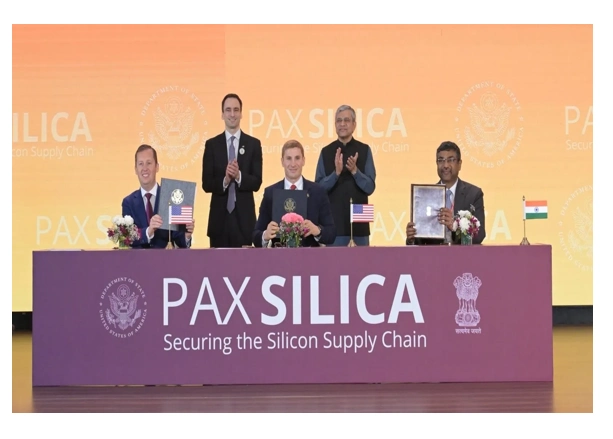

In what could be seen as a tectonic shift of the global order of technological powers, India and the United States have officially signed the Pax Silica Declaration.
The signing, during a ceremony of the last day of India AI Impact Summit 2026 at Bharat Mandapam, was much more than just a diplomatic formality. It is a “silicon shield” in place for India that ensures that the world’s most populous nation can quietly and reliably rely on access to cutting-edge AI chips, the literal brains of today’s world, which have arguably become the most embattled resource on Earth.
“Today is a moment where we are not signing document, we are securing 1.4 billion dreams,” Union IT Minister Ashwini Vaishnaw said as he exchanged the signed declaration with US Under Secretary of State Jacob Helberg. “Pax Silica is the bridge that ensures Indian innovators never have to stand in line for tools to build the next generation of AI.
Pax Silica – From Beyond the Hardware
The name itself — Pax Silica — is a conscious tip of the hat to historical moments where peace reigned, such as the Pax Romana. For good measure, it’s a mix of the Latin word for Peace (Pax) and SIlca — code name for the most basic element of silicon chip, the one you’ll find in everything from an iPhone to Generative AI’s big server farms.
Backed started in late 2025 by the US State Department, the partnership started out as a small club of traditional allies like Japan, South Korea and the UK. India’s entry today is pivotal. It reimagines the alliance from the Western-centric bloc into a truly global partnership, one that encompasses the “world’s back office” and its emerging tech laboratory.
At its foundation, the declaration is an agreement of “trusted geography.” It creates a secure loop for:
Critical Mineral Extraction Making sure that you get your rare earth elements used in chips from partners, not opponents.
- Fabrication and Design: Marrying the design capabilities of Silicon Valley to India’s multiplying semiconductor ecosystem.
- Logistics and Energy: Securing the steel-and-silicon paths — including a newly announced subsea cable, America-India Connect — through which both data and hardware zoom around the globe.
- Putting a Human Face on the Tech: Why This is Important to the Average Person
The talk of “2-nanometer chips” and “GPU clusters” can be abstract, but the human stakes of this deal are very real. The Pax Silica Declaration, for the Indian startup founder in Bengaluru or the student at a rural polytechnic, is a promise of Digital Sovereignty.
For the typical Indian:
Cheaper AI Services: Stable chip access leads to cheaper computing power, which results in more affordable AI tools for healthcare, agriculture and education.
Job Security in High-Tech: In Big Chip, businesses like Mantua’s AMD and NVIDIA and other international chip manufacturers search for “trusted” chip factories as India–a new Pax Silica state—is becoming the most charming home to multi-billion dollar “Fab” investments.
Educational Leapfrogging: Whether in academia or industry, Indian universities are teaching their students on the very hardware used by Silicon Valley and reducing the “lag” that has historically been part of the equation when it comes to tech education in India.
Read more: Modi pitches India as an artificial intelligence hub at the AI summit
The Road to 2047: A Full-Stack Collaboration
The summit was more than just a signature. It came with a spate of “Ground Reality” announcements. Sundar Pichai, the chief executive of Google and a participant in the signing, noted on his Twitter account that his company is already training 20 million Indian public servants in artificial intelligence. The deep infrastructure ties between India and OpenAI are justified in part by the “extraordinary talent density” he sees in the country, Sam Altman of OpenAI said.
In other words for Bharat Mandapam: “ The ‘India AI Impact Summit 2026’, Has shifted the needle from intent to infrastructure. India is not just “pitching” itself as a hub anymore; with Pax Silica, India has, in effect, plugged in to the high-voltage grid of the global tech elite.
As the delegates left into the New Delhi evening, there was a sense of quiet triumph. The age of “Pax Silica” has dawned, and for the first time in history, India isn’t just riding shotgun on the tech train — it’s helping to lay the tracks.

A versatile writer mainly works on trending news, daily updates from politics, business, crime, current affairs and entertainment.