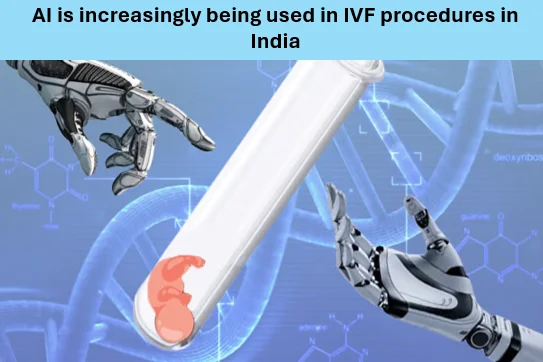

There are at least six big fertility chains in India that use AI to help pick out eggs and check DNA. Some people question the science behind disease risk scores.
In India, a couple who choose in vitro fertilisation can now find out which of their embryos has a higher risk of getting heart disease, diabetes, or Alzheimer’s years or even decades before the disease shows up.
It won’t be a report. It’s likely to happen
This number, the polygenic risk score, was derived using artificial intelligence to analyze genetic differences in an embryo’s DNA. It shows that India’s fertility business is changing in a big way.
As of the beginning of 2026, AI tools were being used in IVF services at at least six large fertility groups and a number of smaller hospitals across the country. There are two main types of tools: those that look at pictures of sperm and/or embryos to guess how well they will attach, and those that look at DNA to guess how likely it is that a child will get sick.
In March, the New York based company Nucleus Genomics teamed up with Indira IVF, which was founded in Udaipur, Rajasthan, and is India’s largest fertility service provider, to offer polygenic screening at the cellular level. Indira IVF says it performs about 42,000 IVF cycles a year across its 160 centers nationwide.
Then, Gaudium IVF in Delhi joined forces with IVF 2.0 in the UK to use two image-based tools called ERICA and SiD.
Nova IVF Fertility, which is also based in Delhi, began using Sigma Embryo, an AI system developed by Kai Health in South Korea, at 120 centers across 65 Indian towns.
Read also: India’s first ‘AI in a box’ unveiled in AI summit
The business sense is clear
According to the market research company Techsci Research, India’s IVF market was valued at $961 million in 2024 and is expected to reach $1.49 billion by 2030. This was because people are waiting longer to have children, the number of infertile couples is rising, and the middle class is becoming more willing to pay out of pocket. The United Nations’ 2025 State of World Population Report said that about 27.5 million Indian couples have trouble getting pregnant.
There is a lot less agreement on the clinical, moral, and legal issues that this growth in the fertility business brings up, especially when it comes to DNA based screening.
How AI helps choose embryos
During IVF, doctors tell the couple’s ovaries to make more than one egg, fertilise the eggs in a lab, and then choose which baby to move to the uterus. Not all eggs can become babies, and one of the biggest problems in fertility science is still finding the ones that are most likely to work.
Time lapse photography, which takes pictures of growing embryos all the time, is one of the most important tools. These methods look at both morphokinetics, which is how fast the embryo grows and splits, and morphology, which is how the embryo looks. AI can help figure out which baby has the best chance of succeeding by mixing these inputs with mathematical models.
Gaudium IVF implemented a system called ERICA in April. It compares pictures of embryos with large datasets from the past to identify the ones most likely to implant. SiD does the same for sperm by looking at their movement patterns under a microscope to identify the ones most likely to produce an egg.
Gaudium IVF’s founder and executive director, Dr. Manika Khanna, was clear about what the tools could do. “That tells you how healthy the embryo is going to be for putting down roots in the womb,” she said.
Read also: Tips for Best Nutrition and Best Maternity Hospitals During Your Pregnancy
How does polygenic risk score work?
The need for careful choice of foetus compounds with age. A healthy adult cell has 46 chromosomes, with 23 pairs holding the genetic blueprints for the body. An egg can become non-viable with just a small mismatch, which can cause implantation failure or a loss.
He also said, “It gets harder to find a viable embryo as the patient ages, and it’s more important than ever to find the right one quickly.”
You can use PGT-A (Preimplantation Genetic Testing for Aneuploidy) and PGT-M (Preimplantation Genetic Testing for Monogenic disorders) to help with this. PGT-A checks to see if an embryo has the right number of chromosomes and can find problems that can lead to miscarriage or conditions like Down syndrome. PGT-M checks for thalassaemia and sickle cell disease, which are inherited alone genes. For both, an embryo sample is needed, in which a small group of cells are taken out and studied in a lab.
Each DNA variation is given a weight that shows how strongly it has been linked to a certain disease in studies of big populations. When you add these weights together, you get a single number that shows where a person is on a risk scale. The number doesn’t mean that someone has a disorder; it just shows where that person fits in with the rest of the community.
It’s not a new idea. PRS was created as a study method for the first time around 2007. It started being used in IVF around 2019 to score embryos before they are implanted.
Murdia from Indira IVF said that this way of using AI is limited and starts with the parents, not the eggs.
Each IVF cycle at Indira IVF costs around Rs 1.8 lakh to Rs 2.5 lakh. When you add in more genetic testing, the costs go up by another 2–3 lakh per round. For many Indian families, the cost of IVF is already too high.

I am a versatile content writer from the MP region, covering politics, business, crime, current affairs, entertainment, video games, and sports with clear insights, engaging analysis, and timely, reader-focused updates.