
India has started testing its own cell radio alert system across the whole country. It is part of the SACHET technology and is meant to send out fast emergency alerts. The new technology gets around SMS delays and gets to users in seconds. Its goal is to make emergency response and public safety across the country much better.
India just finished one of its biggest public safety technology tests by putting its own Cell Broadcast Alert System (CBAS) to the test across the whole country.
The National Disaster Management Authority (NDMA) and the Department of Telecommunications (DoT) are behind the effort. It is a big change in how people get real-time disaster alerts.
The system is part of a larger warning system called SACHET (Integrated Alert System), which was created in the United States by the Center for Development of Telematics (C-DOT).
The test, which took place in all 28 states and 8 Union Territories, is the next step in the review of a technology that is meant to send almost instantaneous alerts during emergencies.
“In the future, this same system will be able to send instant alerts in the local language and based on where the person is in case of an emergency or disaster.” This project is a big step toward making people safer and making sure that information gets out quickly during disasters. Jyotiraditya Scindia, the Union Minister for Communications, wrote on X.
What took place during the test of the national alert?
Just before noon on Saturday, May 2, 2026, cell phones all over the country started vibrating and making a loud, noticeable sound.
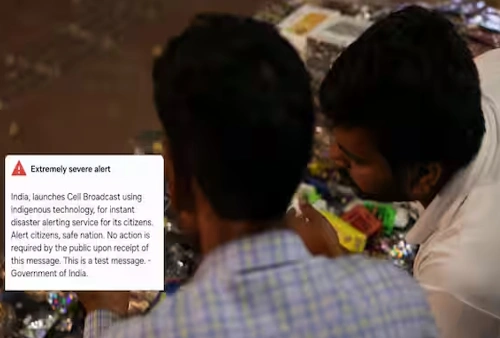
At the same time, devices showed a full-screen warning with the words “extremely severe alert” clearly visible. The message was first shown in English, then in Hindi, and in many cases in other regional languages as well.
The warning was made in a way that made it impossible to ignore. Even on devices that were set to “Do Not Disturb” or “Silent Mode,” the message and alarm-like sound were shown.
This function was added on purpose to make sure that important alerts are seen no matter what the user settings are.
Officials also made it clear that some users may get the message more than once. As part of the testing process, different cell towers and telecom networks are checked to see how well they work and how reliable they are.
The government said again that people who get these kinds of texts during the testing phase don’t need to do anything.
Read also: WhatsApp May Add 15 Minute Auto Delete Messages Feature to Strengthen Privacy
What is the SACHET technology, and how does it fit in?
The CBAS is part of the larger SACHET (Integrated Alert System) tool, which is meant to be India’s main way of communicating about disasters. The platform was made by C-DOT in-house and shows a push toward independence in important technical infrastructure.
SACHET combines several ways to send alerts, but cell radio is becoming its most advanced part.
The platform lets the government send out warnings through a variety of methods, but the addition of cell radio makes these messages much faster and more widely available.
One important thing about the structure is that it is native to the area. India is less reliant on foreign companies for vital facilities linked to public safety by creating the technology in-house.
This method also lets you tailor it to local needs, such as sending messages in multiple languages and focusing on people in certain regions.
Read also: Audio message across stations discouraging suicides: Kolkata Metro’s initiative
How does the science behind cell radio work?
Cell radio is very different from other types of text tools. Instead of sending separate messages to each phone number, it uses the technology of the mobile network to send one message to all devices in a certain area that are linked to the same cell tower.
A one-to-many model is used by this method. Depending on the service area, a single broadcast from a tower can reach tens of thousands or even millions of devices at the same time.
The message that sent the alert said, “India launches Cell Broadcast using its own technology for instant disaster alerting service for its citizens.” Alert people, safe country. The public does not need to do anything after receiving this news. This message is just a test. The Indian government.
Since the system doesn’t depend on individual links, it doesn’t have the problems that happen when the network is very busy and SMS communication is slowed down.
Cell towers and mobile devices regularly talk to each other, which is used by the technology. Usually, this exchange gives background data that is needed to join to a network.
On the other hand, the same system can be used to send emergency alerts directly to phones, without needing phone numbers or registration.
Geo-targeting is another important part. Instead of sending texts all over the country, the government can send alerts to specific areas, like a town, city, or district. This accuracy helps keep people outside the damaged area from getting too scared.
Cell broadcast also allows international messages, so alerts can be sent out in Hindi, English, and other regional languages. This makes sure that advice can be seen by a wide range of people, which is very important in a country with a lot of different languages.

A versatile writer mainly works on trending news, daily updates from politics, business, crime, current affairs and entertainment.