
As you knit or ride your bike, there are some things you do without giving them much thought.
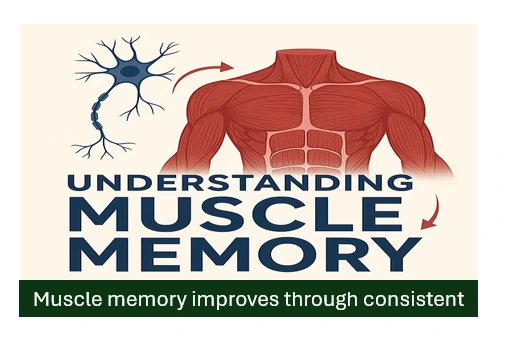
These are often linked to the idea of “muscle memory,” which says that your body can remember how to do difficult tasks and, over time, learn to do them on its own.
But do your muscles remember what you did? What part does your brain play? Let’s look at science.
What does “memory of muscles” mean?
Most of the time, “muscle memory” refers to things we do or skills we learn without giving them much thought. This could include things like tying your shoelaces, riding a bike, or playing an instrument.
But cognitive scientists don’t call this kind of memory “muscle memory.” Instead, they call it “procedural memory.” Even though it doesn’t always feel like it, our brains and bodies work together to remember how to do something.
“Muscle memory” can also mean the way that muscles seem to get bigger or stronger after being taught. This idea is backed up by research that shows training before building muscle can speed up the process. This might be done by changing the way muscle cells work or are built. Scientists still don’t know how all of this works, though. Any way you look at it, these changes mean that muscles can’t “store” memories or knowledge like the brain can.
What you need to know about procedural memory
Procedure-based memory is a type of “non-declarative memory,” which means it is based on acts rather than words. It can be hard to share skills you’ve learned through procedural memory because of this.
Let’s say you’re teaching a kid how to ride a bike. You can easily do all the right things at the right times if you get on the bike yourself and hold the handlebars, mount the bike, and push the pedals. But telling someone about that process is much harder, especially if you only use words.
According to research, the best and fastest way to improve your procedural memory is to do something over and over again. It takes a lot of work to learn a new skill at first. This is because you have to be in charge of everything you do to make sure you do things the right way and in the right order.
These skills can become so natural that you don’t even have to think about them. For instance, you might drive home and forget the road you took. It’s because you’re doing a set of things you’ve done hundreds of times before.
A lot of different parts of your brain have to work together to keep your basic memory strong. This is because when we learn a skill actively and then when we do it automatically, our brains use different processes.
The pre-frontal and fronto-parietal parts of the brain are used a lot when you learn something new. These have to do with paying attention, remembering things, and thinking carefully and consciously.
Sensorimotor circuits take over when you start to repeat and practise a skill. Your senses pick up information from the outside world and help your brain figure out the best way for your body to react. This makes it possible for you to do hard things with less mental effort.
Do you remember how to do things when you have dementia?
What’s interesting about procedural memory is that it doesn’t change much as you age.
Most of the time, jobs that take conscious effort are the hardest for people with dementia or other types of cognitive decline. But they often remember more natural skills that they’ve learned over the course of their lives. For this reason, you might meet people with dementia who can still knit or dance the tango even though they have trouble calling their friends and family.
Researchers have found that music is a very strong way to access basic memory. A study in Canada found that people with Alzheimer’s dementia, a brain disease that can’t be cured and affects memory, thinking, and behaviour, could understand words better when they were sung than when they were spoken.
People with cognitive problems may also be able to learn new skills and remember old ones better with procedural memory. Researchers in Australia wanted to find out if a person with very bad Alzheimer’s could learn a new song. A 91-year-old woman with serious Alzheimer’s who had never played music before was able to learn a brand-new song. The words were hard for her to remember on a memory test, but she could sing the song again after two weeks.
Read also: How to Inculcate Discipline in Your Kid
Can procedural memory be made better?
It’s too bad there isn’t a quick and easy way to improve your artificial memory.
To start learning a new skill, you have to get through the first few stages, which usually take a lot of work and focus. This is where getting better comes in. When you practise a new skill, your brain will rely less on the parts that handle attention and more on the parts that handle physical tasks.
To get the most out of your practice, you might want to spread it out over more than one time. Forcing yourself to remember something and rebuild it, even after you’ve stopped thinking about it, is what this does. You’ll get better at making and remembering long-term memories as a result. It might also help to get some sleep after each exercise session. Researchers think this is because sleep helps you remember things and keep the skills you learn.
It takes time and work to improve basic memory, but it’s well worth it. Getting better at something will make your life better. And the skills you learn over a lifetime can help you stay in touch with the people and events that are important to you, even if your mental health gets worse.

I am a versatile content writer from the MP region, covering politics, business, crime, current affairs, entertainment, video games, and sports with clear insights, engaging analysis, and timely, reader-focused updates.