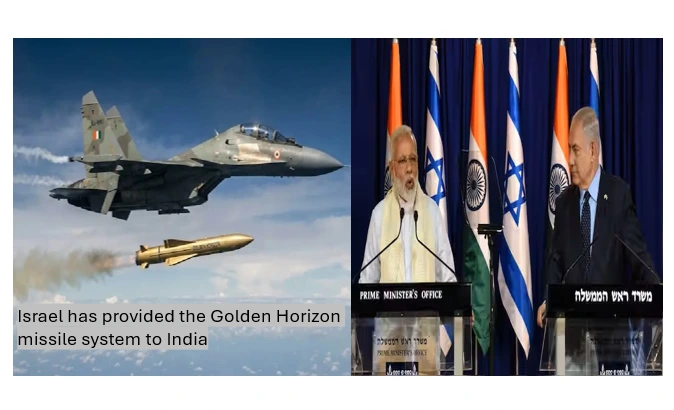

Prior to Prime Minister Narendra Modi’s trip to Israel, Yisrael offered India one of its newest air-launched ballistic missiles (ALBMs) called the Golden Horizon. If India does go through with the proposal, it will be the first country in the world to receive this advanced weapon system from another country. This will mark a milestone in the defence relationship between India and Israel.
The Golden Horizon is an air-launched ballistic missile developed in Israel that is thought to be a derivative of the prior Silver Sparrow target missile. According to defence experts, it is a long-range, high-speed, deep-strike weapon with very high accuracy against underground hardened targets. Estimates say that the missile can travel distances from approximately 800 km up to 2000 km depending on launch parameters and configuration.
Unlike a typical cruise missile, the Golden Horizon is classified as a ballistic missile and travels in a highly arched trajectory (therefore) reaching hypersonic speeds (greater than Mach 5) during its approach making it much more challenging to hit with any existing Air Defence Systems (ADS) currently in operation.
Integration with Indian Air Force
Currently there are plans to incorporate the Golden Horizon into the Indian Air Force’s Sukhoi-30MKI Multi-role aircraft allowing for an advanced deep-strike capability from an aircraft without the need for specific Bomber aircraft.
This represents a significant upgrade to India’s capabilities for a stand-off strike against an enemy, in addition to the existing BrahMos supersonic cruise missile which has a much shorter range.
Military experts point out that because Golden Horizon is able to be launched from operationally deployed fighter aircraft, India has increased operational flexibility to hit strategic targets without entering hostile airspace.
Strategic and Regional Implications
If consummated, this transaction will substantially strengthen India’s deterrent posture and facilitate long-range strike operations in a complicated security environment involving both Pakistan and China. A hypersonic air-to-surface weapon could allow India’s aircraft to destroy high-value targets such as hardened command/control facilities and missile support infrastructure with decreased exposure to enemy air defense systems.
Military analysts have evaluated the competitive landscape for this type of capabilities; no other countries currently export an analogue of the air-launched ballistic missile system, which has the potential to significantly alter the military balance within the region. On the one hand, Pakistan lacks such capabilities and is therefore less militarily competitive than India. On the other hand, China’s reported capabilities are also not available for export.
Official Confirmation Still Pending
Customs officials have not yet been able to find either Indian or Israeli governments to confirm publicly, to date anyway, the sale proposal last proposed; it is believed however, that defence officials within New Delhi are reviewing the proposal as part of overall discussions between the two leaders in anticipation of PM Modi’s upcoming visit.
Background and Overview of Developments Between India and Israel’s Defence Cooperation
This procurement will serve to further strengthen the existing defence relationship between India and Israel which is one of India’s most longstanding partners in defence cooperation. The two nations have established close collaboration over many years on various levels of missile defence, radar technologies, and other strategies systems.
If purchased, the Golden Horizon will represent a departure from past technology transfers as the shift from mainly defensive systems and platforms, to implementing long-range precision offensive weapons. Suppliers suggest that the inclusion of this new method of military action has both reflected India’s changing security needs as well as how deeply both nations have integrated their defence infrastructures.
Read also: 2026 as the India-France year of innovation- PM Modi
Opinion of Leaders and Impediments to Successful Acquisition
According to numerous experts, the introduction of a new advanced ALBM system such as the Golden Horizon will result in both technical and logistical integrations and therefore will necessitate major changes in both doctrine and procedure throughout the IAF. Adaptations will be needed throughout the various aircraft design systems, targeting systems, maintenance protocols, training and rules of engagement associated with the operation of the aforementioned weapons system. Planners responsible for implementing new defence programs will also have to develop appropriate programmes to balance any acquisitions made through this procurement initiative against existing indigenous missile development capabilities.
What’s Next?
During the peak time of establishing bilateral negotiations between India and Israel, defence Ministers and officials are expected to discuss Golden Horizon and other strategic areas of cooperation. The information determined from these meetings will ultimately impact the future of air capability strikes in India and the overall defence relationship between India and Israel.

A versatile writer mainly works on trending news, daily updates from politics, business, crime, current affairs and entertainment.









