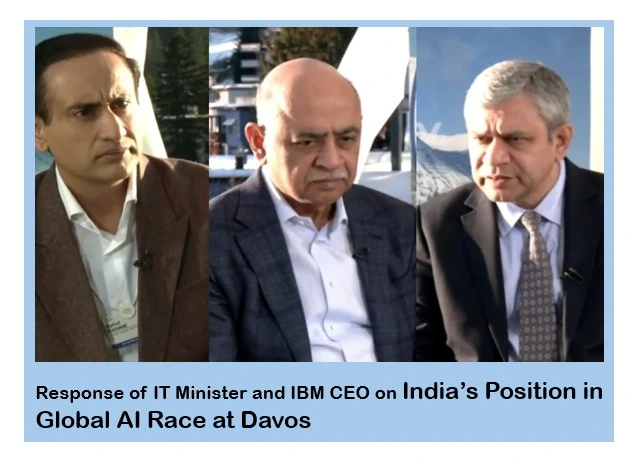

At the World Economic Forum in Davos, important people from the government and the tech world answered questions about India’s place in the world of artificial intelligence (AI). Ashwini Vaishnaw, Union Minister for Electronics and IT, and Arvind Krishna, Chairman and CEO of IBM, talked about whether India is behind China and the US in technological progress and new ideas in AI. They said these things during talks with the media and group discussions at the annual meeting of world leaders and experts in their fields.
Leaders say India is not falling behind
When asked if India is behind the US and China in AI, Arvind Krishna said that this view doesn’t take into account how innovations work and how markets change. He disagreed with the idea that Indian companies don’t have the right technology or study to make big discoveries. Krishna instead stressed that a lot of India’s AI work is focused on using AI in the real world, coming up with new business ideas, and improving current technologies to meet real-world business needs.
Krishna said that there has been a change in the business from doing basic study to making solutions that work, bring in money, and solve problems in certain areas. He said that big basic AI models with trillions of parameters will become commoditized, which means they will lose their competitive edge and become common tools instead of sources of new ideas.
Krishna said that India shouldn’t just compete with very large models, but should also work on making smaller, more focused AI models that are filled with its own data and can help many different types of businesses. In his argument, he said that this method could open up huge chances for creativity and capital investment in India’s tech environment.
The government talks about its sovereign AI strategy
This point of view was backed by Union IT Minister Ashwini Vaishnaw, who explained India’s plan for AI, which focuses on autonomy and sector-specific solutions. He said that India has already used sovereign AI models in serious national situations, such as defense projects, with great results. The minister said that these results show that specialized AI uses can get good results without depending only on very big models made in other countries.
Vaishnaw said again that India’s method to AI is based on creating a group of smaller, more efficient models that are each built for a particular purpose. He said that this approach brings together leadership from the public sector and new ideas from the private sector to boost the economy and make the country more technologically independent.
Setting of the Global AI Competition
The question of whether India is behind the US and China in AI is part of a larger global argument about who is in charge of technology. The US and China have put a lot of money into big core models and AI research, which helps them be seen and do business in global markets. But the speakers at Davos said that India’s strengths lie in a different part of the AI value chain.
Krishna said that AI’s value changes over time from low-level systems and simple models to real-world apps that solve problems. He said that India could benefit from this change because it has a lot of skilled workers and a lot of experience with business software, even if it isn’t the leader in all areas of basic AI study.
India is focusing on using AI to solve business problems, meet infrastructure needs, and meet national data standards. This is part of the country’s larger digital strategy, which combines widespread digital adoption with focused innovation.
The views of business and government come together
India’s AI future will be shaped by strategic decisions, not just by comparing itself to global rivals, as both the government and business pointed out at Davos. Officials and business leaders stressed that it is just as important to make AI systems that are useful and meet social and economic goals as it is to find new ways to do research.
Their comments also emphasized that more and more people agree that AI development is not a race to the bottom. Instead, each country can be the leader in a different part of the ecosystem, ranging from basic science to specialized application layers. India may be strong in the latter.
Indian’s changing role in the world of AI was talked about at Davos. Strategies that might help India fight on innovation and economic effects were also brought up. This is while major powers continue to spend a lot in basic technology.

A versatile writer mainly works on trending news, daily updates from politics, business, crime, current affairs and entertainment.