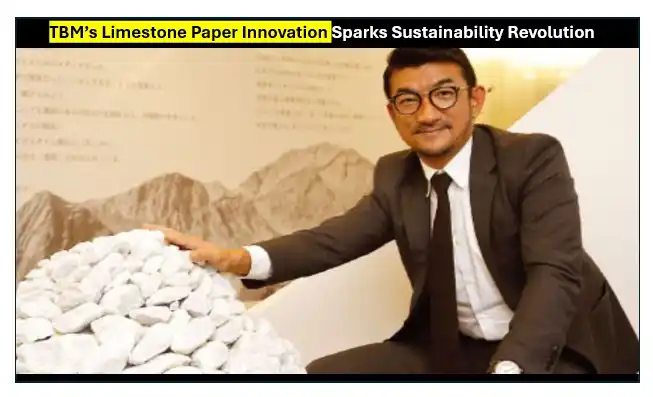

When it comes out in February 2026, the startup’s new CirculeX technology should solve two of the biggest problems with recovered plastic- how long it lasts and how bad it smells.
Twenty years ago, a Japanese company called TBM set out to make paper from limestone. Their eco-friendly LIMEX material is now used for everything from business cards to shopping bags. With their new CirculeX technology, they are now working with recovered plastic. This technology makes goods even harder than those made from new plastic.
When it comes out in February 2026, CirculeX claims to solve two of the biggest problems with recovered plastic: how long it lasts and how bad it smells. The new product is said to be 126% stronger than regular post consumer recovered plastic and 60% less smelly.
Nobuyoshi Yamasaki, CEO of TBM, told ThePrint, With over a decade of experience in developing new content, we have turned PCR (Post Consumer Recycled) plastic, which used to have poor quality and low value, into a better resource.
From LIMEX to CirculeX
TBM has made a name for itself in the last 15 years by developing new and recycling sustainable content. It is now used by over 10,000 businesses and cities in more than 10 countries, and it has filed 250 patents. TBM’s real strength, though, is the exact science and engineering that goes into making their products, whether it’s carbon capture, recycled plastics, or their own LIMEX design.
Yamasaki said, “Just like the Industrial, IT, and AI revolutions, we are now facing a global challenge to bring about the Sustainability Revolution.”
read also:
- Apple at 50 transforming technology into emotion
- Google Launches Gemma 4 AI Model
- 5 Iconic Devices That Defined Its Legacy
What LIMEX is based on
Yamasaki found “stone paper” while he was in Taiwan in 2008. This is a product made from recycled building materials. I was really interested in the idea, so Yamasaki wanted to sell these goods in Japan too. But he saw that they weren’t selling well as they were heavy, expensive, and not very good.
So, Yamasaki chose to make a new type of stone paper in house by using limestone, which was easy to come by. On TBM’s website, it says that limestone is a resource that “Japan can be 100% self-sufficient in.” If TBM uses limestone to make plastic or paper, it can also use less of other limited resources like gasoline, wood, and water.
TBM’s website said, “The amount of limestone used in LIMEX made at our own factory is only 0.01% of the amount used in Japan.” “The world’s population will continue to rise, and so will the need for plastics and paper. Limestone is easy to get and doesn’t cost much, making it a great alternative to plastics and paper as a raw material.”
The process of making LIMEX is not easy
Limestone derived calcium carbonate is finely ground and mixed with thermoplastic resin to make pellets. These pellets are then shaped into sheets like paper or shapes like plastic bags or containers. TBM says that making LIMEX uses 94% less water than making regular paper. This means that LIMEX is a more environmentally friendly medium.
When the first plant opened in 2015, business cards were the first successful product made with LIMEX. Even though LIMEX now makes notebooks, menus, lighted film signs, and other printed contents, Yamasaki still brings his own product with him on business trips, to events, and to foreign meetings.
But in 2023–24, TBM made another big step forward when they made LIMEX from carbon dioxide they had collected. The “Next Generation LIMEX” was introduced at the World Economic Forum in Davos in 2024. It is a change from using direct limestone to making LIMEX by turning collected CO2 emissions into calcium carbonate.
“First, we directly capture CO2 from emissions made by power plants, factories, and places that burn trash,” TBM told ThePrint. “Next, we mix waste streams from places like steel mills and concrete plants with water and only take out the calcium.” “Then, we use chemistry to react that calcium with CO2 to make CCU calcium carbonate,” they said.
With this product, TBM has entered the market for carbon capture and usage (CCU). There are also plans to open a CCU plant in Vietnam, which is still in the works. The Japanese government also wants to make more CCUs through its Ministry of Economy, Trade, and Industry. But TBM is already ahead of the game.
According to TBM, the Japanese government’s plan said that CCU goods like chemicals and concrete would start being sold around 2040. However, TBM was able to start selling them about 15 years earlier.

I am a versatile content writer from the MP region, covering politics, business, crime, current affairs, entertainment, video games, and sports with clear insights, engaging analysis, and timely, reader-focused updates.