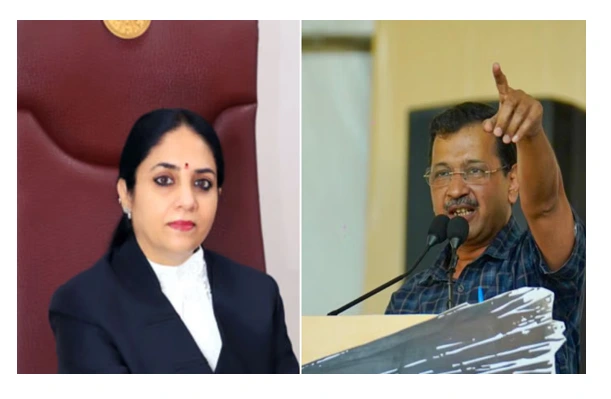

“The judge in Delhi High Court said, “I just cannot recuse myself because of false allegations. If I did, it would be giving support to an attempt to cast a shadow on this court.”
In a dramatic turn in the Delhi excise policy case, Delhi High Court judge Justice Swarana Kanta Sharma refused to step down from hearing the case on Monday. She did this despite requests from former Delhi chief minister Arvind Kejriwal, former deputy chief minister Manish Sisodia, Aam Aadmi Party leader Vijay Nair and other accused who said she was biased and had a conflict of interest.
After a day of heated court proceedings, Justice Sharma issued the order, saying that none of the applicants’ reasons for asking her to step down were valid. She said that granting such requests based on “unfounded allegations” would undermine the judiciary’s freedom and set a bad example.
Kejriwal named the family members of this court who are on the panel
Kejriwal named family members of this court who are on the panel, but they have never worked on this case, the judge said. She also rejected claims of a conflict of interest, noting that her children are on the panel as central government lawyers. “Am I being told that my independence as a judge is at risk?” she asked.
Justice Sharma also didn’t agree with the idea that her past decisions against Kejriwal and other charged people showed bias. The judge’s ability cannot be called into question because a higher court overturned its orders, she said. “A politician or an accused politician cannot cross a boundary,” she added.
The judge said that an accused person who is afraid of getting a bad verdict could not “arm-twist” the court in this way. If they did, the judge said, the rich and powerful would start using the court to suit their own needs.
When Kejriwal first spoke in public, he said, “I have the utmost respect for your honour, and I don’t think this court has any bad intentions.” No one can say bad things about a judge who is already in office without proper information or proof. It is not okay for a politician, no matter how strong or weak he is, to bring shame on an institution.
The court said, “I just cannot recuse due to manufactured allegations otherwise it would be giving credence to an attempt to cast a shadow on this court.” They said this while pointing out that judges should have an open mind and not an empty one.
Justice Sharma also said that the courtroom was not a stage of impression
The court’s image was not built in a day but through case after case and year after year. “If this court withdraws without a good reason and only based on what people think they want, it would set a dangerous precedent of deciding cases based on how someone feels,” the court said.
“This is not a case between two litigants; it is a case between the litigant (the accused) and me, the judge,” Justice Sharma said.
In response to claims that she had attended events put on by the legal wing of the RSS, the judge said that going to legal programs did not mean that she supported or was biased by certain ideas. “I don’t understand how taking part in a legal program could be linked to bias in my mind,” she asked.
The order was supposed to come down at 2:30 p.m. Monday, but it wasn’t made public until after 6:30 p.m., after the court let Kejriwal make more arguments, including new reasons for recusing himself. One reason was that the CBI was said to have ignored reports that the judge’s children were in central government groups.
read also
- ED attaching Rs 441 Crore assets in liquor scam case
- Delhi Liquor Policy Case Update: High Court Pauses Trial Court Remarks
- Congress was loyal to the rule that banned booze
Solicitor General Tushar Mehta representing the CBI
He said that the application was based on “unfounded allegations.” He also said that letting these kinds of recusal pleas go through would make people more likely to put pressure on courts. He also didn’t like it when new cases were added to the record after the court had reserved its orders, saying that this almost never happened.
Kejriwal directly presented his case and gave many reasons for asking Justice Sharma to step down. Some of these were her earlier refusal to help him when he challenged his arrest, her refusal to let co-accused people like Sisodia and K. Kavitha go free on bail, the claimed “strong and conclusive” findings made in earlier hearings, and what he called “undue haste” in how this case was handled.
He also used the Supreme Court’s decision in Ranjit Thakur vs. Union of India (1987) to say that the test for bias should not be based on how the judge sees it, but on how a fair person could see it.
There were, however, repeated attacks on the judges’ honour on social media, and Justice Sharma said that if they gave in, it would be “an attack on the institution.”
The recusal plea added another dramatic layer to the long-running Delhi booze policy case. This was especially true after, on February 27, a trial court freed Kejriwal, Sisodia, and others, saying that the CBI’s case could not stand up to legal scrutiny.

I am a versatile content writer from the MP region, covering politics, business, crime, current affairs, entertainment, video games, and sports with clear insights, engaging analysis, and timely, reader-focused updates.