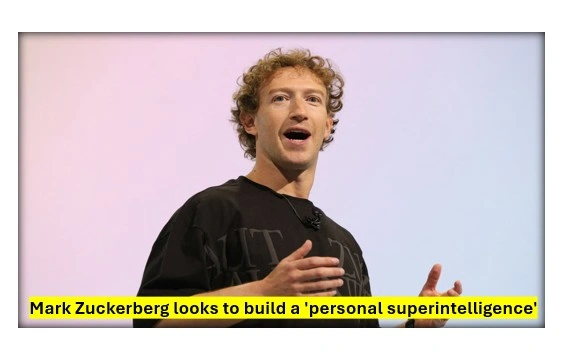

We can now officially say goodbye to the “Year of Efficiency.” Inside Meta On Wednesday, Jan. 28, 2026, Meta CEO Mark Zuckerberg signalled a significant new direction for the business — because this isn’t about cutting costs off Facebook’s appeal to advertisers or on the moderation of content — and staffing up an enormous offensive operation at high velocity. In the Q4 2025 earnings call, Zuckerberg announced a vision beyond cliché chatbots and social algorithms — one that he calls “Personal Superintelligence.”
But to invest in this ambitious leap, Meta is also planning to nearly double its capital expenditure, forecasting the range of $115 billion to $135 billion for 2026. This is a huge step up from the $72 billion on R.&D. in 2025, effectively transforming Meta into an A.I. infrastructure company that also runs social networks.
What is “Personal Superintelligence”?
That’s because while the tech industry continues to be dominated by thinking about “Artificial General Intelligence (AGI)” — a centralized, god-like AI that is capable of being better at everything than a human being — Zuckerberg has chosen an entirely different approach. His vision for Personal Superintelligence is Decentralization and Empowerment.
Rather than being a single AI that lives in the cloud, Zuckerberg dreams of an assistant that is everywhere you are and knows everything about you.
- Empowerment vs. Automation: Where competitors emphasize automating jobs, Meta aims to deliver a virtual assistant that helps you achieve your own desires and enhances your creativity by acting as a “second brain.”
- The Wearable Interface: The main interface for this intelligence will not simply be your phone, it will be Ray-Ban Meta smart glasses. Sales of the glasses tripled in 2025, Zuckerberg said, a sign that the world is ready for “always-on” AI that can see what you see and hear what you hear.
- Agentic Commerce: There will be an emphasis in 2026 on AI agents that understand your tastes and social circles well enough to make shopping, travel booking and other complex jobs of life admin happen on their own.
Meta Compute: Building the Gigawatt World
To build that level of smarts, Meta has created a new high-level organization called the Meta Compute group. It’s not just about buying more H100 chips; it is a bet on gargantuan, multidecade level physical infrastructure.
The company aims to establish tens of gigawatts of AI data center capability for this decade, scaling up to hundreds of gigawatts in the future. To put that into context, it only takes about one gigawatt to power 750,000 homes. Meta is not just a software company anymore, it is transforming itself into a utility-scale energy and hardware empire.
“AI is becoming more and more code for ‘Capex,’” one analyst observed after the call. Zuckerberg is wagering that in the battle over A.I., the victor won’t just have the smartest algorithms, but also the most steel and silicon — and possibly even some marble and stone.
That includes a newly announced $6 billion agreement with Corning to purchase high-end fiber optic cable and the firing up of Prometheus, Meta’s first purpose-built AI supercluster, expected to be operational by mid-2026.
Financial “Fountain”:Arming the Race
The amount being spent — as much as $135 billion in a year — is so large that it would normally cause investors to scramble for the hills. But Meta’s stock shot up nearly 10 percent in after-hours trading. Why? For the simple reason that the “cash fountain” of its core advertising business is flowing more freely than ever.
- Revenue Record: Meta had record Q4 2025 revenue of $59.89 billion, up 24% year-over-year.
- Ad Efficiency: Ad targeting is already worth the cost of using AI, and is very creepy. Ad impressions increased 18%, while the average price per ad was up 6%.
- User Engagement: The Instagram Reels watch time has grown 30%; Threads is a significant cultural force with engagement time increasing by 20%.
- CFO Susan Li was blunt: After spending all of that, Meta expects to produce higher operating income next year than it did in 2025. The company is essentially leveraging its social media monopoly to fund its transition into an AI giant.
The Open Source Question
For years Meta has been the “hero” of the open-source community, which it has giving away its Llama models. But as the company marches toward “real superintelligence,” Zuckerberg suggested a turn ahead.
Although Meta continues to embrace the ethos of open source, he cautioned that “new safety interests” as well as the scale of these models could influence how much they shared. The 2026 roadmap implies that while the “base” models may be open, the true Personal Superintelligence—the one with access to your raw data and their proprietary Meta hardware—will probably remain a closed, premium experience.
Conclusion: The Final Pivot
Mark Zuckerberg is back in “Founder Mode.” He has overcome the early “metaverse” skepticism by anchoring it in the material, lucrative realm of A.I. By 2026, Meta is not just developing an app; it’s building a digital exoskeleton for the human mind.
If Zuckerberg is correct, we’re at the cusp of a mass transition from “searching for information” to “directing our intelligence.” The $135 billion wager is that a year from now, millions of us will be gazing through Ray-Ban-framed glasses onto a world illuminated by a superintelligent software platform that wields billions of data points to anticipate our whims better than we know them ourselves.
Five Bold Tech Predictions for 2026- Why Wall Street May Be Underestimating AI Growth

A versatile writer mainly works on trending news, daily updates from politics, business, crime, current affairs and entertainment.