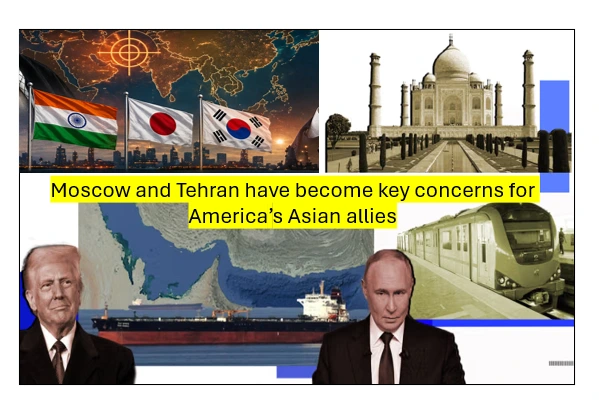

The media around the world also talk about the Mughals, the rise of the BJP in India, and the problem of low traffic in India’s subway system as it grows.
The US’s Asian partners have had to go after its enemies in the oil market because of the war with Iran. Oil supplies are still unstable because they depend on the Strait of Hormuz.
American friends and key partners in Asia didn’t buy Russian oil because they knew it would be against Western sanctions. And many of them didn’t do much business with Iran, which is another major source. The fight between the US and Israel and Iran has changed all of that, according to The New York Times.
It is “now top of the agenda” to set up a meeting or phone call with leaders in Russia or Iran. Japan, South Korea, the Philippines, India, and Indonesia all want to buy crude oil from Russia and other countries.
India has moved away from Russia because it is close to signing a trade deal with the US. This is especially true since US President Donald Trump put harsh taxes on New Delhi for buying oil from Russia. The story says that India stopped getting oil from Iran in 2019 because of US sanctions against Tehran.
To “place” the US, India was almost ready to switch from Russian oil to energy sources from West Asia in the past few weeks. This plan was ruined by the attacks on Iran by the US and Israel and the blockade of the Strait of Hormuz that followed. NYT says that India had to go back to getting Russian oil by boat, but at a higher price.
The Economist has a piece that asks, “What have the Mughals ever done for us?”
“(Prime Minister) Narendra Modi has talked a lot about India’s history of slavery in speeches to supporters, to parliament, and to the whole country.” It says that soon after he became president in 2014, he complained that “the mentality of 1,200 years of slavery continues to haunt us.” The statements were aimed at the Muslim countries that came before British rule. And of all of them, the Mughal kingdom took the longest.
“Mr. Modi’s Bharatiya Janata Party (BJP) says the Mughals destroyed temples, which is true, and put Hindus down, which is not.” What India had was taken away by them. It also asks, “What did they ever give us in return?” the story says.
The Mughals gave India language, food, building, and culture. They also did one more thing: they put the BJP in power.
When the study talks about the 1992 destruction of the Babri Masjid, it says that the BJP’s share of seats in Parliament rose from 16% before the destruction to 56% by the time a Ram temple was dedicated on the site of the mosque.
Report says that for most of the last ten years, BJP has changed the names of Mughal towns, turned down Mughal food, and erased the Mughals from history books.
“It is one thing to tear down a building made of bricks and cement. It is harder to get rid of a society that has been a part of India for more than 500 years. So, that’s the best answer to their question about what the Mughals have done for them. “They made political Hinduism’s villain for all time,” says The Economist.
Nikhil Inamdar writes for the BBC about the problem of traffic in India as the metro system grows
The study says that less people are using the metro, which is “confronting the breakneck expansion of India’s metro network.”
Narendra Modi’s government has spent more than $26 billion since 2014 to connect almost two dozen Indian towns to the metro. By 2025, the network will have grown from less than 300 km to more than 1,000 km. Over 11 million people ride the tube every day, almost four times as many as three million people did ten years ago.
But the growing network has “failed to achieve even a sliver of the ridership” that was hoped for when it was first planned.
“The Observer Research Foundation (ORF) think tank says that ridership in some tier-3 cities, like Kanpur in the north, was as low as 2% of the projected estimate. In Chennai, in the south, it was 37% for the first phase,” the report says.
“Capital Delhi, which has India’s largest metro network, may be the only place where usage has slightly gone over expectations.”
But transport experts told the BBC that the Delhi metro has started counting each exit as a separate ride, which is making the number of riders appear higher than it really is.
The study asks, “So why has metro travel been so hard in a country where few people own cars and other public transport systems are crowded and overworked?”
read also
- As Trump’s US Embargo Begins, Iran Warns of Retaliation Across the Region
- With Hormuz closed, Lebanon on fire, and talks going on in Islamabad
There are several reasons
A travel expert told the BBC that it’s hard to figure out how many people will actually use the service, and that numbers are sometimes inflated to show that the project is “economically viable.”
Second, the problem of cost. Another transport expert said, “In Indian metro systems, the integrated journey cost can consume 20 percent of income for low-income workers, which is higher than the global benchmark of 10-15 percent.”
The study says that bad network planning and lack of last-mile connectivity are two other problems that keep demand low. It also says that there aren’t enough connecting buses to help with door-to-door connection.
“India also has problems with bad walkways and safety concerns for women,” it says.

I am a versatile content writer from the MP region, covering politics, business, crime, current affairs, entertainment, video games, and sports with clear insights, engaging analysis, and timely, reader-focused updates.