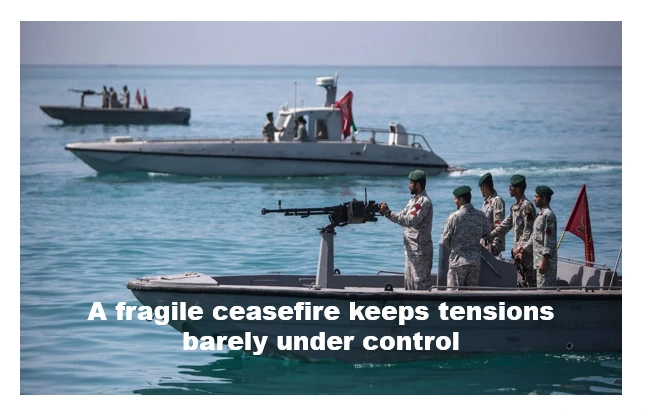

A weak peace between the US and Iran was put under even more stress when Tehran said it had closed the Strait of Hormuz again, saying Israel had broken the deal by attacking Lebanon. This new information has made it less clear what will happen with a deal that depended on keeping an important oil route open.
Reopening the Strait was a key part of the earlier announced two-week agreement. Washington wants to ensure trade can proceed safely before official talks begin. With this new move, the agreement could be broken before the talks even start.
The Revolutionary Guard of Iran also said that they would fight back if the strikes on Lebanon kept up
Pakistan’s Prime Minister Shehbaz Sharif, who has helped to keep the peace, said that breaches had been seen in some parts of the battle zone. For the next two weeks, he asked everyone to be calm and follow through on the agreed-upon break.
But the US has said that Lebanon was never a part of the plan for a ceasefire. President Trump said that Hezbollah’s acts from Lebanon make things more difficult. White House sources said again that the deal does not cover Lebanon.
Mohammad Bagher Ghalibaf, Speaker of Iran’s Parliament, said that Washington was breaking promises by violating territory and continuing military operations.
Hormuz’s situation is still unclear, which adds to the confusion
US Defence Secretary Pete Hegseth said the Strait was open and that trade would continue around the world. General Dan Caine said the assessment was based on information from diplomats.
On the ground, though, things didn’t look as clear. Iran let a few ships pass for a short time before saying the border would be closed again, blaming Israeli attacks.
Read also: Israel Targets Iran’s Nuclear Facilities in Escalating Conflict
Despite a shaky peace, the US moves forward with talks in Islamabad
The US is still going ahead with planned talks, even though emotions are still high. Along with ambassador Steve Witkoff and Jared Kushner, Vice President JD Vance will take a group to Islamabad to negotiate with Iran.
The White House said that the goal of the talks is to build on what it called a “decisive military phase” that came after “Operation Epic Fury.” Officials said that the action put pressure on Iran to agree to the truce and think about closing the Strait.
Before the meeting, Vance said that the truce is just the beginning. He said that the deal says the US will be careful as long as Iran keeps the Strait open, and he warned that if Iran didn’t follow through, bad things would happen.
He also made it clear that the talks will be focused on Iran’s nuclear program, repeating Washington’s stance that Tehran should not work on making nuclear bombs.
Read also: US Fires Over 850 Tomahawk Missiles at Iran: Pentagon Concerned
Here are the most important changes:
Iran told ships going through the Strait of Hormuz that there were other ways they could take because of the danger of sea bombs in the main part of the important waterway. In the message, there were directions for a different way to enter and leave the gap.
Wednesday, the Trump administration said that Lebanon was not a part of the truce agreement. Karoline Leavitt, the press secretary for the White House, said, “That has been communicated to all parties.”
JD Vance, the vice president of the US, also told reporters in Budapest that the US had never promised to include Lebanon in the ceasefire and that Iran may have thought that because of a “misunderstanding.” Israel said on Wednesday that it did not think the truce between Iran and the US covered Lebanon.
Karoline Leavitt also said that the idea that Trump is working from the original 10-point plan put forward by Tehran was “misreported.” She said that Trump “literally threw away” the 10-point plan that Iran gave in public, even though Trump had said on Truth Social that the US had gotten a 10-point plan from Iran that was thought to be a “workable basis on which to negotiate.” In fact, Leavitt said that Iran had given the president a “more reasonable, completely different, and condensed plan.”
Emmanuel Macron, the president of France, said that he had asked Donald Trump and Masoud Pezeshkian, the presidents of Iran and the US, to include Lebanon in the agreement that they reached with Iran. The Australian foreign minister has asked the same thing.
In a private meeting with Mark Rutte, the Secretary General of NATO, Donald Trump released his anger at the organization. At the time, ties between the two countries were at an all-time low. After more than two hours at the White House, Rutte told CNN, “I can see his point. He is clearly disappointed with many NATO allies.” “This was an honest and open conversation between two good friends.”
Sir Keir Starmer will continue his trip through the Middle East on Thursday. He met with Mohammed Bin Salman, the Crown Prince of Saudi Arabia, as part of ongoing talks with partners to make the Strait of Hormuz safer for ships.

I am a versatile content writer from the MP region, covering politics, business, crime, current affairs, entertainment, video games, and sports with clear insights, engaging analysis, and timely, reader-focused updates.