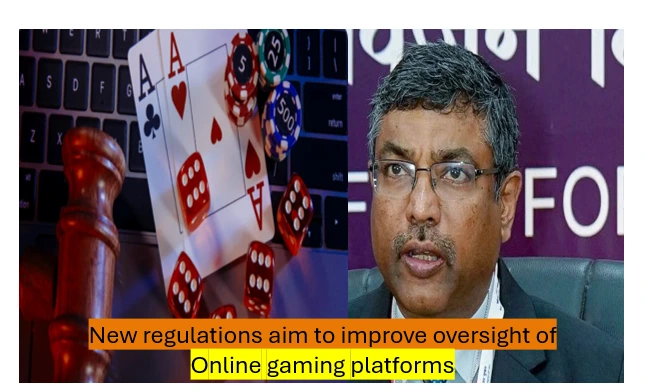

Now, a game will be placed in a category only if the authority chooses it on its own, if the provider wants to offer it as an e-sport, or if the center specifically designates a category.
The Promotion and Regulation of Online Gaming Rules, 2026, were made public on Wednesday evening. The biggest real change is that most online games in India will no longer need to be approved by a referee before they can be played. These rules will take effect on May 1, 2026.
“You don’t have to be determined or registered to offer a game unless you want to offer it as an e-sport,” S. Krishnan, secretary of the Ministry of Electronics and Information Technology (MeitY), said at a meeting on Wednesday.
No longer does a game have to be classified unless it is directly flagged by the central government, the authority, or the provider that wants to offer it as an e-sport. So far, nothing has been marked.
The rules came eight months after the Promotion and Regulation of Online Gaming Act was passed by Parliament in August 2025. This law completely banned real money gaming and shut down platforms like Dream11, MPL, and WinZo. It also set up the legal authority that will start working on May 1.
E-Sports and online social games were made official by the Promotion and Regulation of Online Gaming Act, 2025. However, all online money games were made illegal.
A central Gaming Authority was set up to keep track of which games are allowed and which ones are not. The rule was made because people were worried about teens becoming addicted, businesses losing money, and people using games to hide money. But critics said it got rid of the long-standing legal difference between games of skill and games of chance.
Several High Courts received challenges to the constitution, and the Supreme Court heard all of them in order to make a final decision. Things are still not clear.
Lookout gets a new member
The October 2025 draft called for an authority with a chairperson and five members: two director-level members, at least one of whom would be a lawyer; and three joint secretary-level officials from the ministries of Information and Broadcasting, Youth Affairs and Sports, and Financial Services.
The new rules get rid of the two director positions and add five joint secretaries instead: one for Home Affairs, one for Financial Services, one for Information and Broadcasting, one for Youth Affairs and Sports, and one for Legal Affairs.
There was no Home Affairs in the draft at all. Its addition shows that the government thinks action against illegal overseas platforms, scams, and money laundering is an important part of the authority’s job, not something that isn’t important.
“There is an enforcement mechanism in the Ministry of Home Affairs,” Krishnan said, confirming that the MHA is linked to enforcement.
The number needed for a quorum drops from one-third to half. Decisions about emergencies must be sent to all members within three days, not seven.
read also
- ARC Raiders 2026 roadmap: Confirmed content from January to April
- Everything You Need to Know About Gaming Glasses: A Complete Guide
- Why a Chinese Billionaire Wants 20 American Sons to Rule His Gaming Empire
An entire anger level was removed
The draft rules said that user complaints would go through three levels: first, the game provider; then, the IT Intermediary Rules 2021 Grievance Appellate Committee; and finally, the authority.
The Grievance Appellate Committee was not involved at all in the rules that were made public. Users now have 30 days to go from provider to authority to the Appellate Authority, which is the MeitY Secretary. A layer of red tape that was only there on paper for seven months was taken away before it could do its job.
Part II of the draft was all about promoting e-sports and online social games. The Ministry of Youth Affairs and Sports and the Ministry of Information and Broadcasting were both in charge of this part. The informed rules get rid of this whole part.
Sri Krishnan said, “That is mostly a policy matter that doesn’t need to be part of basic rules.”
A temporary rule from the draft that said banks had to return customer deposits made before the Act went into effect within 180 days has also been taken away. It looked like Krishnan said the problem had been solved.
In both, banks are part of the compliance process. But the rules that were made public go even further: banks must check a game’s registration license before they can process a transaction for a registered e-sport or social game.
When the government tells banks to stop or suspend all transactions linked to an online money game, they must do so right away and give the government any information it asks for. In the draft, there was no similar duty for aggressive proof.
There is still no way to play web games for real money. “You can’t play money games.” It’s not possible to decide on money games. “If we find out that someone is playing money games, we have to punish them,” Krishnan said.

A versatile writer mainly works on trending news, daily updates from politics, business, crime, current affairs and entertainment.









